Smart Home Gyms: Are They Worth It for a UK Spare Room?
Most UK spare rooms measure somewhere around 9 square metres. Smart home gyms with digital resistance can fit that space, but the annual subscription cost often exceeds the price gap between a smart unit and a basic bench-and-dumbbell setup.
For UK home trainers choosing between smart home gyms and traditional free weights, the short answer is this: smart systems suit people who want coached, varied workouts and have no interest in building a weight collection. Adjustable dumbbells suit people who want full control over their own programming and lower costs over time.
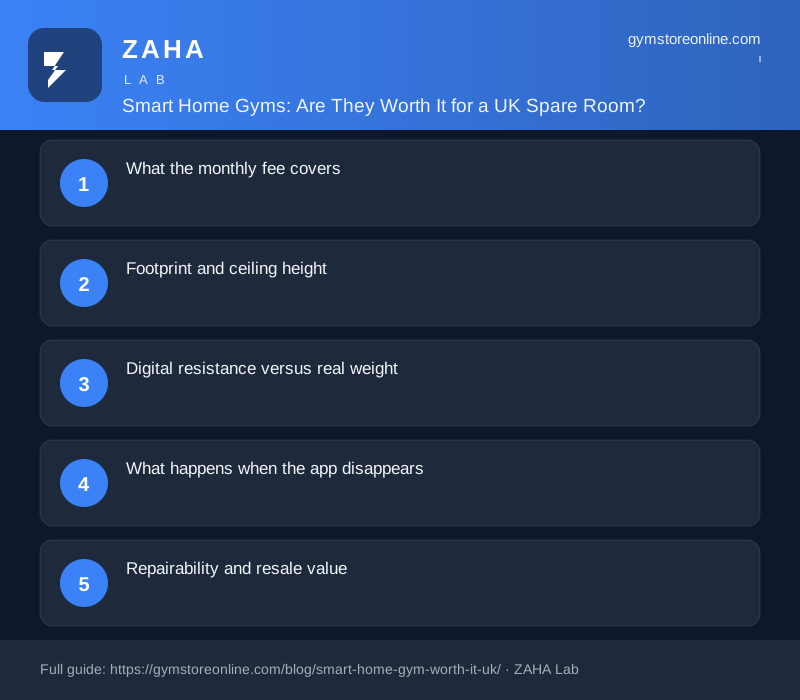
What the monthly fee covers
The subscription on most smart home gyms gives access to the coaching interface, the workout library, and the automatic resistance adjustment. Without it, many units revert to basic manual mode or lose the features that justify the price. Some manufacturers confirm this in their terms; others leave the detail buried. Read the cancellation policy before you buy.
Coaching quality varies considerably between platforms. Some offer live sessions with real-time form feedback via a camera; others are pre-recorded programmes with no meaningful personalisation. Check what is actually in the subscription tier you are buying, not just the headline features in the marketing.
Footprint and ceiling height
Most all-in-one smart cable systems need roughly 1.2 m by 1.8 m of floor space, plus a 1.5 m clear zone in front for movement. The ceiling is the bigger constraint. Overhead press and lat pulldown typically require at least 2.2 m of clearance, and many UK conversion flats and Victorian terraces fall below that. Measure the room before ordering.
Traditional setups are more flexible. A folding bench stores upright against a wall. Adjustable dumbbells sit on a shelf. Training around a low ceiling is straightforward if you stick to seated and lying movements.
Digital resistance versus real weight
Digital or electromagnetic resistance feels different from iron. Most users describe it as smoother through the range of motion, without the natural deceleration of a free weight at the top of a curl. That smoothness suits higher-rep or rehab-focused training. For heavy compound lifts where inertia matters, free weights remain the better tool.
Adjustable dumbbells replicate free-weight feel exactly, because they are free weights. A cable crossover machine with a physical weight stack gives cable-specific angles and genuine loaded resistance, with no subscription and no server that can go offline.
What happens when the app disappears
Several connected fitness companies have shut down or discontinued app support in the past four years, leaving hardware that became partially or fully unusable. Before committing to any smart system, find out whether the machine works without the app and whether resistance is adjustable via physical controls. Ask the retailer whether UK spare parts are stocked outside warranty.
A bench and a set of dumbbells will work in 2040. The motor controller on a subscription machine may not.
Repairability and resale value
Smart home gyms with proprietary electronics are difficult to repair once the warranty expires. Out-of-warranty motor or sensor failures often cost more to fix than the machine's second-hand value. Resale is harder too: buyers discount units where the coaching app is tied to the original account or requires a new subscription from the next owner.
Traditional kit holds value well. Quality adjustable dumbbells and a folding bench typically retain most of their purchase price on the second-hand market, particularly in cities where storage space is tight.
Gear worth considering
Both paths have solid options. See the full range on the Gym Equipment page.
- AEKE S1 Pro smart home gym with AI trainer: an all-in-one cable system with app-guided coaching and automatic resistance adjustment. Compact enough for a spare room, and best suited to trainees who want structured, coached workouts without building a weight collection.
- GYM MASTER cable crossover machine with a 180 kg weight stack: a full cable crossover station with genuine plate-loaded resistance and no subscription required. Takes more floor space but works indefinitely without an app. The cable machine buying guide covers setup and installation.
- 6-in-1 adjustable dumbbell and barbell kit: converts between dumbbell and barbell configurations, replacing a full rack of fixed weights in a fraction of the space. Pairs with a folding bench for a complete free-weight setup in around 2 square metres. The adjustable dumbbells guide explains what to check before buying.
Frequently asked questions
Can I use a smart home gym without paying the subscription?
Most units offer limited basic functionality without an active subscription, but the coached workout library and automatic resistance programming typically require a live plan. Check the manufacturer's terms for your specific model before purchasing.
How much ceiling height do I need for a cable-based home gym?
Most cable stations and smart gym units need at least 2.1 to 2.2 metres of clearance for overhead exercises. If your room is shorter, you can still train effectively by focusing on seated, lying, and mid-cable exercises instead.
Are adjustable dumbbells a good alternative to a smart gym system?
For most UK home trainees, yes. A quality adjustable dumbbell set covers the majority of strength training exercises at a fraction of the annual cost once subscription fees are factored in. The trade-off is that you need to plan your own sessions or follow a separate coaching app.