Cable Machines for a Home Gym: What to Check Before You Buy
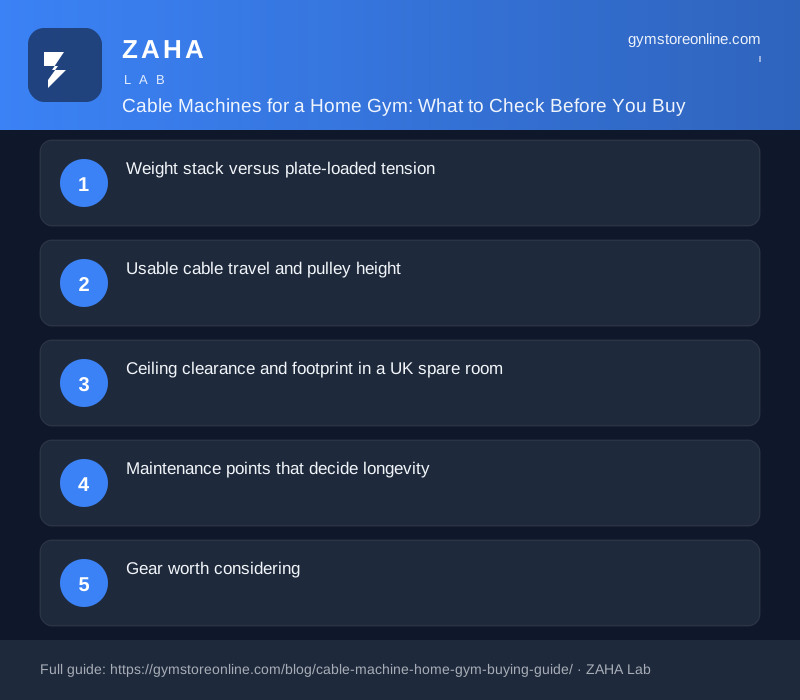
A cable machine for a home gym can sit unused within six months if you buy the wrong spec. What separates a machine you will actually train on from an expensive clothes horse comes down to weight-stack resistance, cable travel, and whether the footprint fits a UK spare room. Browse Home Gym Equipment for a broader view of what pairs well with a cable station.
Weight stack versus plate-loaded tension
Most home cable machines use one of two resistance systems. A weight-stack machine has a fixed column of plates you select with a pin. Plate-loaded versions use standard weight discs and cost less upfront, but they require you to already own a set of plates and to load them between every set change. For most home users, a weight stack between 80 kg and 120 kg covers every lat pulldown, tricep pushdown, and cable row in a typical programme. A 180 kg stack is overkill unless you are training competitively or sharing the machine with multiple strong adults.
Check the pulley ratio before buying. Many machines apply a 2:1 ratio, meaning a 100 kg stack delivers roughly 50 kg of felt resistance at the handle. The headline weight figure does not tell you this. Read the spec sheet.
Usable cable travel and pulley height
Usable cable travel is the distance the weight stack can move, not the total cable length. For a full lat pulldown from arms extended overhead to bar at chest level, you need at least 120 cm of usable travel. Face pulls and high-cable rows work best when the top pulley sits at least 210 cm from the floor. Many budget machines stop at 190 cm, which forces an awkward pull angle on every rep. Measure from your floor to the top pulley before ordering, not from a product photo. A low pulley also limits overhead tricep extensions, which require the cable to travel in a near-vertical arc above the head.
Ceiling clearance and footprint in a UK spare room
Standard ceiling height in UK homes built before 1980 is around 240 cm. Many cable machines stand 210 to 230 cm tall, and the weight-stack guide rods that protrude above the top plate add another 15 to 20 cm. Measure the tallest listed dimension of the specific machine against your actual ceiling before ordering. A garage is often safer than a spare bedroom: single-garage ceiling heights commonly reach 245 to 250 cm, which gives the rod clearance you need.
Footprint matters as much as height. A standalone cable crossover frame can occupy 150 cm x 120 cm of floor space, which fills a 3 m x 3 m room fast once you add a bench. A 2-in-1 machine that combines a cable station with a rower compresses two pieces of equipment into one footprint, typically saving 1 to 1.5 square metres. For a tight spare room or a single-car garage bay, that difference is real. See the home exercise machines guide for more on planning a small training space.
Maintenance points that decide longevity
The cable itself is the first thing to inspect on any used machine and the first thing to replace on a heavily used new one. A frayed cable is a safety issue and typically costs £15 to £30 to replace if you source it from a rigging supplier rather than through the original manufacturer. Check the pulleys: they should spin freely with no lateral wobble. The weight-stack guide rods need a light coat of silicone spray every three months to prevent the plates binding and jerking. Nylon bushings in budget machines wear within 18 to 24 months of regular use; sealed bearings last considerably longer. On plate-loaded machines, confirm the weight horns are rated above the total load you plan to use, including collars. Wipe the steel frame monthly: surface rust starts cosmetic but, left untreated, it weakens welds over several years.
Gear worth considering
The following options cover different budgets and room sizes:
- GYM MASTER cable crossover machine with a 180 kg weight stack: a full-size dual-pulley station suited to garages with adequate ceiling clearance and users who want a large resistance range.
- TOUSAINS CR63 2-in-1 home gym cable machine and rower: combines cable training with a rowing station in one frame, a practical choice for spare rooms where floor space is tight.
- Home gym rowing T-bar and V-bar pulley cable machine: a compact plate-loaded option for users who already own standard weight discs and want a lower entry cost.
- AEKE S1 Pro smart home gym with AI trainer: uses digital resistance rather than a physical weight stack, which cuts the footprint substantially and suits flats where floor loading is a concern.
If you are also weighing up a rack to pair with a cable machine, the squat rack buying guide covers what to look for in a UK home setting.
Frequently asked questions
How much ceiling height do I need for a home cable machine?
Most freestanding cable machines stand between 210 and 230 cm tall, and the weight-stack guide rods add a further 15 to 20 cm above that. A ceiling of at least 245 to 250 cm gives a safe margin. Measure the tallest listed dimension of the specific machine you are considering, not a generic figure.
Is a weight-stack or plate-loaded cable machine better for a home gym?
Weight-stack machines are faster to adjust mid-session, which matters if you are supersetting exercises or training alone. Plate-loaded machines cost less upfront and let you use discs you already own, but they require changing plates between sets. A weight stack of 80 to 100 kg covers the needs of most home gym users without requiring extra floor space for stored plates.
Can I use a cable machine in a flat?
Yes, with some checks first. Confirm the floor-loading limits in your lease and the assembled weight of the machine: a fully loaded weight-stack unit can exceed 200 kg. Digital-resistance machines like the AEKE S1 Pro are significantly lighter and may be a better fit where floor loading or landlord restrictions apply.