Four Home Fitness Benchmarks Worth Retesting Every Eight Weeks
Most home trainees weigh themselves weekly and still feel unsure whether they are actually fitter. These four home fitness benchmark tests take under 40 minutes to run and give you concrete numbers to retest every eight weeks, no gym membership or coach required.
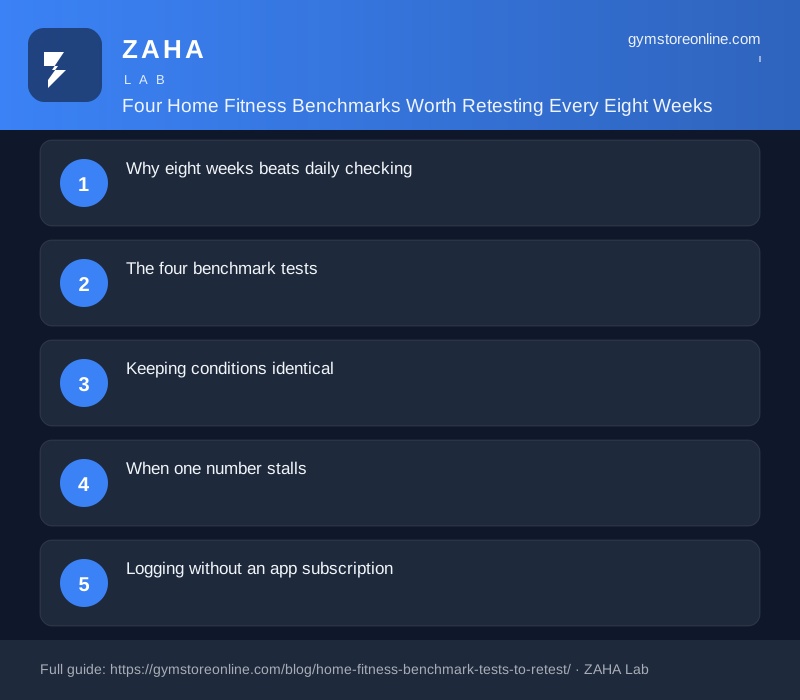
Why eight weeks beats daily checking
Progress in fitness is slow. A single bad night's sleep, a heavy meal, or a stressful morning can shift your performance numbers by 10 to 15 percent in either direction. Daily retesting captures noise, not adaptation. Eight weeks is long enough for genuine cardiovascular and muscular changes to register, and short enough that a stalling result still leaves time to adjust before the year is out. Four cycles per year gives you a clear annual trend without obsessing over week-to-week fluctuations.
The four benchmark tests
Timed bodyweight set. Choose either press-ups or bodyweight squats, not both. Perform as many clean repetitions as possible in two minutes. Record the number. Use the same variation every time: full press-ups or incline press-ups, parallel-stance squats or narrow-stance squats. Switching between variations makes the data worthless.
Grip or loaded carry. If you own a pair of dumbbells or kettlebells, carry them for 30 metres along a measured distance in your hallway or garden. Record the time. No equipment? Hang from a door-frame pull-up bar and record how many seconds you hold before your grip fails. Both versions measure the same quality: functional strength endurance under sustained load.
Step or stair test. Find a single step, a stair, or a low box roughly 20 cm high. Step up and down at a steady pace for three minutes, then sit quietly and count your pulse for 15 seconds. Multiply by four. That is your recovery heart rate in beats per minute. A lower number after the same three-minute effort indicates improving aerobic fitness. For more context on training at different intensities, see the guide to heart rate zones for home cardio.
Rest-interval recovery check. Immediately after the step test, count how many seconds it takes for your breathing to feel fully normal again. Write it down. This is a crude but repeatable proxy for recovery capacity. It costs nothing and needs no device.
Keeping conditions identical
The numbers only mean something if the conditions match. Run the tests on the same day of the week, at the same time of day, in the same footwear, and after the same warm-up: five minutes of light movement, nothing more. Do not retest the day after a hard session or during illness. Eat a similar meal beforehand each time, ideally two to three hours before you start. Write these conditions down on the day of your first test and repeat them exactly.
For the step test specifically, use the same step height every time. Mark it with a piece of tape if necessary. A step that measures 20 cm one month and 25 cm the next will make the comparison unreadable.
When one number stalls
It is common for two or three measures to improve while one stays flat. That is information, not failure. If your timed bodyweight set climbs but your step-test recovery score does not, your strength endurance is ahead of your aerobic base. Add one or two low-intensity cardio sessions per week. The zone 2 cardio at home guide explains the intensity level to aim for. Cardio Equipment can make those sessions more structured if you want to add a machine to your space.
If grip or carry time stalls while everything else improves, increase the frequency of loaded carries or hanging work. Small targeted changes beat wholesale programme overhauls.
Logging without an app subscription
A single sheet of A4 paper works. Use four columns: date, test name, result, conditions note. After each retest, draw a horizontal line and add the new row beneath. Keep the sheet in the same spot where you train. After six months you will have a visual record that no app can delete, update, or hide behind a paywall. Take a photo of the sheet before each retest as a backup.
Gear worth considering
None of these tests require equipment, but a few affordable additions make retesting more consistent and your training between cycles more effective.
- A weighted jump rope adds structured aerobic variety between test cycles and helps build the base that improves step-test recovery scores over time.
- A 2-pack non-slip treadmill mat gives you a stable, defined surface for step testing and loaded carries, particularly useful on laminate or wooden floors in a flat or spare room.
- A universal rowing machine mat protects the floor and prevents equipment movement if you use a rower as part of your aerobic training between benchmarks.
Frequently asked questions
Can I substitute a different exercise if I cannot do full press-ups?
Yes. Wall press-ups, incline press-ups against a worktop, or bodyweight squats are all valid alternatives. The key rule is to use the same variation at every retest. Switching exercises mid-programme makes the numbers incomparable.
Do I need a heart rate monitor for the step test?
No. A 15-second manual pulse count multiplied by four gives a usable figure without any device. Place two fingers on the side of your neck or on your wrist immediately after the three-minute step, count for exactly 15 seconds, then multiply by four to get beats per minute.
What if my results vary a lot between retests even when conditions seem the same?
Some variation is normal, with swings of around five to eight percent between sessions in well-rested adults. If variation is larger than that, check sleep, hydration, and whether the testing time of day is truly consistent. A single outlier result is worth noting but not acting on until the next retest confirms a trend.