Zone 2 Cardio at Home: How Much You Need and the Best Equipment to Get There
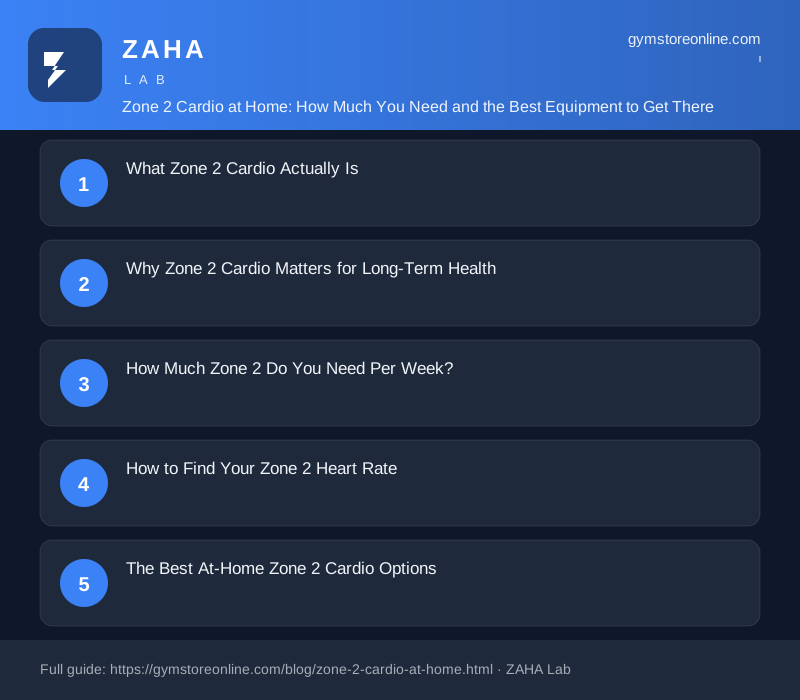
The hardest part of effective cardio is slowing down. Most people train at an intensity that is too high to build aerobic fitness and too low to push strength gains. Zone 2 cardio, working at 60-70% of your maximum heart rate, is the most evidence-backed approach to improving VO2 max, metabolic health, and longevity. Adults need 150 minutes per week. A home gym covers every minute of it.
What Zone 2 Cardio Actually Is
Zone 2 refers to the second of five heart rate training zones. At this intensity, your body burns primarily fat for fuel and your mitochondria adapt most efficiently. You should be able to hold a full conversation without pausing to breathe. If you are gasping after a sentence, back off the pace.
The zones are defined relative to maximum heart rate (MHR). Zone 1 sits below 60% MHR. Zone 2 runs from 60 to 70%. Zone 3 covers 70-80%, zone 4 covers 80-90%, and zone 5 is anything above 90%. Elite endurance athletes spend roughly 80% of their training volume in zones 1 and 2 combined. That is the 80/20 principle, described by sports scientist Stephen Seiler, and the evidence behind it is consistent across cycling, running, and rowing.
Why Zone 2 Cardio Matters for Long-Term Health
Mitochondrial density is the clearest marker of aerobic fitness. Zone 2 training increases both the number and efficiency of mitochondria in slow-twitch muscle fibres. Dr Inigo San Millan, whose research on metabolic health is widely cited, describes zone 2 as the intensity that generates the greatest mitochondrial adaptation without accumulating excess lactate.
The downstream effects are significant. Research shows zone 2 training improves insulin sensitivity, lowers resting heart rate, reduces LDL cholesterol, and increases VO2 max. Studies published in the British Journal of Sports Medicine consistently find that 150 minutes of moderate-intensity aerobic exercise per week reduces all-cause mortality risk substantially compared to sedentary controls. Zone 2 is precisely that intensity.
How Much Zone 2 Do You Need Per Week?
The NHS physical activity guidelines recommend 150 minutes of moderate activity per week, or 75 minutes of vigorous activity. Zone 2 sits squarely in the moderate category.
Three to four sessions of 40-45 minutes covers the minimum effective dose. Dr Peter Attia, whose work on longevity medicine reaches a wide audience in the UK, recommends four sessions of 45-60 minutes weekly for meaningful improvement in VO2 max. That is 180-240 minutes total, slightly above the NHS floor, and achievable in a home gym without commuting anywhere.
Consistency across 8-12 weeks drives measurable adaptation. A single long session at the weekend does not replicate the effect of four shorter sessions spread through the week. Frequency matters more than duration per session.
How to Find Your Zone 2 Heart Rate
The simplest method is the talk test. If you can speak a full sentence comfortably, you are likely in zone 2. If you are struggling after a few words, ease off the pace.
For a numbers-based approach, calculate your estimated maximum heart rate using 220 minus your age. This estimate is accurate to within 10-15 beats for most adults. Multiply by 0.60 and 0.70 to find your zone 2 range.
Example: a 40-year-old has an estimated MHR of 180 bpm. Zone 2 sits between 108 and 126 bpm. A fitness tracker or chest strap heart rate monitor confirms you are holding that range. Polar, Garmin, and Wahoo all produce devices that display real-time heart rate on compatible apps.
The Best At-Home Zone 2 Cardio Options
Several formats work well for sustained zone 2 effort without leaving the house.
- Stationary cycling is the most popular choice for UK home gym owners. It is low-impact, quiet enough for a flat or terraced house, and easy to hold a stable heart rate on. A direct-drive smart trainer paired with a road bike, or a dedicated indoor cycle, gives the most control over resistance.
- Rowing brings the full body in. The stroke rhythm makes it straightforward to settle into zone 2 once technique is established. A 30-minute row at around 20-22 strokes per minute sits comfortably in zone 2 for most fitness levels.
- Incline treadmill walking is underrated for home gym use. A 4-5 mph walk at 10-12% gradient puts most people solidly in zone 2 without the joint stress of running. It is a sensible option for anyone returning from injury or starting from low fitness.
- Jump rope at moderate pace works in a small space. Once the rhythm is established, 20-minute continuous sessions hit zone 2 with no specialist equipment required.
Gear Worth Considering
A few specific pieces make zone 2 training at home straightforward.
[PRODUCT NAME: Indoor exercise bike with magnetic resistance and Bluetooth connectivity] delivers quiet, consistent resistance for long zone 2 sessions. Look for a wide resistance range so the bike stays effective as fitness improves across months of training.
[PRODUCT NAME: Concept2 RowErg rowing machine] is the standard ergometer used by competitive rowers and home gym owners alike. The PM5 performance monitor tracks calories, watts, and split times, all useful proxies for maintaining zone 2 intensity during a session.
[PRODUCT NAME: Chest strap heart rate monitor with ANT+ and Bluetooth compatibility] gives far more accurate readings than optical wrist monitors during steady-state cardio. Accurate data means you spend the session in zone 2 rather than drifting between zones without noticing.
Frequently Asked Questions
Can I do zone 2 cardio every day?
Zone 2 is low enough in intensity that daily sessions are physiologically feasible for most people. That said, 3-5 sessions per week is the range used in most of the supporting research. If you also train for strength or high-intensity intervals, scheduling rest days keeps recovery on track.
Is brisk walking zone 2 cardio?
Often, yes. A brisk walk at 3.5-4.5 mph elevates most people's heart rate into zone 2, particularly for those who are deconditioned. Adding incline or a light weighted vest sustains the stimulus as fitness improves over time.
How long before I see results from zone 2 training?
Resting heart rate typically drops within 4-6 weeks of consistent training. Measurable improvements in VO2 max take 8-12 weeks. Metabolic markers such as fasting glucose and triglycerides respond over 12-16 weeks. Keep sessions consistent and the adaptations follow.
Does zone 2 training replace high-intensity interval training?
Not entirely. HIIT and zone 2 develop different physiological systems. Zone 2 builds the aerobic base; HIIT improves peak VO2 max and lactate threshold. The well-supported split for recreational athletes is roughly 80% zone 2 and 20% higher-intensity work across a training week.