
SPORTNOW Adjustable Weight Bench with Bench Press Rack, Home Gym Bench | Leg Extension, Preacher
£127.99
View on Amazon →
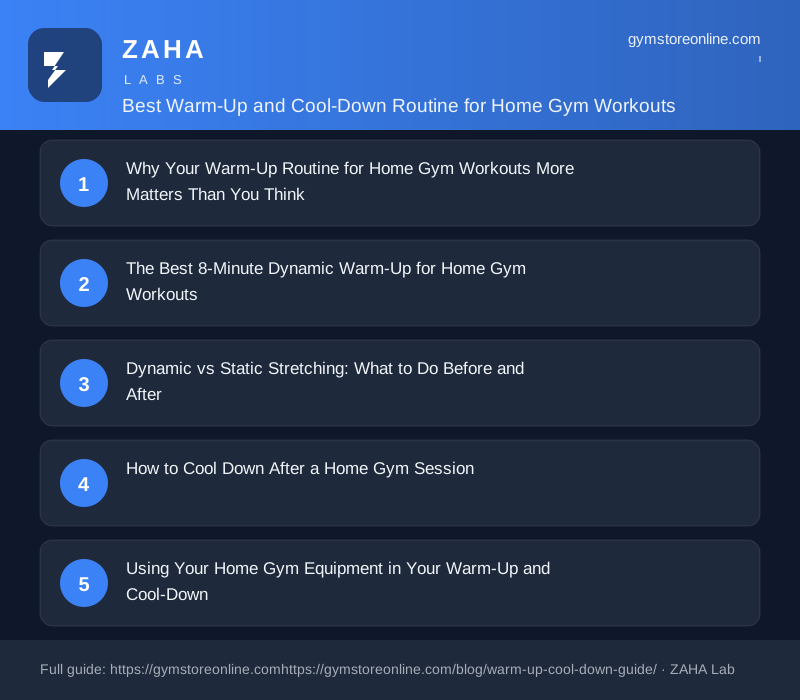
Published 17 September 2026 · updated 2026-09-17 · by GymStoreOnline
Skipping your warm-up doesn't just raise injury risk — it measurably reduces force output, meaning you lift less than your muscles are actually capable of. A proper warm-up and cool-down routine for home gym workouts takes 15–20 minutes total across the session and is the cheapest performance upgrade you'll make this year.
The best warm-up and cool-down routine for home gym workouts pairs 8–10 minutes of progressive dynamic movement before your session with 5–8 minutes of static stretching and controlled breathing afterwards. Adjust timing based on session intensity and the ambient temperature in your training space — a cold garage in January demands a longer pulse-raising phase than a warm spare room in August.
A home gym has one advantage a commercial gym rarely gives you: zero commute, which means you can go from cold to loading a barbell in under two minutes. That is also the trap. Muscles that aren't warm contract less efficiently, tendons that haven't been loaded progressively are more vulnerable to microtears, and joints that haven't been taken through their full range of motion won't stabilise reliably under heavy load.
The warm-up does three things simultaneously: it raises core and peripheral muscle temperature, increases synovial fluid production in the joints you'll use, and activates the neuromuscular pathways your session depends on. None of that happens by showing up and chalking your hands.
It also reduces what physios call the "cold start" problem — the measurable drop in power output in the first few reps of a session. If your top set is your third set, you're building fatigue into your most important work. A structured warm-up means your first heavy rep feels like a working rep, not a test.
Keep your warm-up progressive: begin with low-intensity full-body movement, then layer in mobility and activation work that mirrors your session's movement patterns.
Minutes 1–2: Pulse Raising
Light skipping, marching on the spot, or jumping jacks. The goal is to raise your heart rate and skin temperature, not to fatigue yourself. Two minutes is sufficient — you should feel warm, not breathless.
Minutes 3–5: Dynamic Mobility
Move your joints through their full range without holding positions. Leg swings (front-to-back and lateral), arm circles, hip circles, and shoulder pass-throughs with a resistance band or a broomstick. Ten controlled reps per movement, smooth tempo throughout.
Minutes 6–7: Muscle Activation
Bodyweight squats, glute bridges, and band pull-aparts prime the muscles you're about to load. If your session centres on pressing or overhead work, add cat-cow and thoracic rotations to mobilise the spine before you load it. If you're squatting or deadlifting, add a set of banded clamshells to activate the glutes.
Minute 8: Movement-Specific Rehearsal
One or two sets of your first exercise at 30–40% of your working weight. This is deliberate motor pattern rehearsal — the bar speed should be controlled, your focus on technique, not on the load.
An adjustable weight bench set to a low incline is excellent for supported hip flexor stretches and chest-opener drills before upper-body sessions. The YOLEO Adjustable Weight Bench — ASTM-certified to 300/375 kg with 84–90 position settings — gives stable support at angles a flat bench simply cannot match. Set it to 30–45° and use it for thoracic extensions before pressing work.
This is where most home gym trainees get it backwards — and it costs them either performance or progress.
| Stretch Type | When to Use | Why |
|---|---|---|
| Dynamic (movement-based) | Before training | Raises temperature, activates muscles, improves active range under load |
| Static (held 20–60 seconds) | After training | Reduces muscle tension, supports recovery, builds long-term flexibility |
| PNF (contract-relax) | After training | Most effective method for long-term flexibility gains per session |
| Foam rolling / SMR | Before or after | Reduces soft-tissue tension; limit to 30 seconds per spot before sessions |
Static stretching before training does not prevent injury and may temporarily reduce force production. Save it entirely for your cool-down — this one change is free and takes no extra time.
Your cool-down serves a different purpose to your warm-up. It helps your cardiovascular system return to resting baseline gradually, assists with metabolic clearance from worked tissues, and — if done correctly — is the most effective window in your entire training week to improve flexibility.
Most trainees skip it because they're tired. The irony is that fatigued, warm muscle responds to static stretching better than fresh muscle does. The cool-down is not optional maintenance — it's the flexibility session you've already paid for.
Minutes 1–3: Pulse Lowering
Drop intensity sharply. A slow walk, gentle pedalling, or low-level marching. This prevents blood pooling in the legs and eases the cardiovascular system down without an abrupt stop.
Minutes 4–10: Static Stretching
Hold each position for 30–45 seconds. Breathe steadily and exhale as you deepen into each stretch. Target the muscles you actually worked:
Optional: Foam Rolling
Post-session self-myofascial release on fatigued muscle groups can reduce delayed onset muscle soreness the following day. Focus on 60–90 seconds per area, pausing on tender spots rather than rolling continuously.
Your existing kit is more versatile than most training plans acknowledge.
An adjustable bench is useful well beyond pressing. For warm-ups, a low-incline position provides stable support for hip flexor stretches and upper-back mobilisation. For cool-downs, a flat or slight decline allows a passive chest and shoulder opener — lie back and let gravity do the work over 60–90 seconds.
The OZE SPORTS Adjustable Weight Bench (£39.99, 4.5 stars) offers incline, flat, and decline positions at a price that suits this kind of multi-role use without demanding you justify every angle. If you want more versatility, the YOLEO 400–900KG ASTM-Certified All-in-One Weight Bench Set adds a leg extension and curl fixture — which makes it practical for supported standing quad stretches during your cool-down without improvising with furniture.
A rack isn't only for squats. During warm-ups, the upright frame provides a fixed rail for single-leg balance drills and controlled ankle mobility work. The Yaheetech Adjustable Squat Rack (£49.98, 4.4 stars) includes a functional dip station that doubles as a grip point for loaded hip flexor stretches and ring rows as a thoracic opener. The TOTEBOX Adjustable Squat Rack Barbell Stand includes push-up brackets that create elevated handles for pike stretches and shoulder mobilisation without needing separate attachments.
Some budget squat racks quote a static load capacity, not a dynamic one. When performing overhead press or push press rehearsal sets during your warm-up, the ballistic loading pattern differs from a controlled squat descent. Confirm the product specification addresses dynamic loading before programming bar work at that rack. When in doubt, contact the manufacturer or review the product's test certification documentation before using it for ballistic movement.
Treating your first working set as the warm-up. One light set before going heavy is not a warm-up — it is rehearsal at insufficient tissue temperature. Build through at least three progressive loads before your top set, dropping the rep count as the load increases.
Static stretching before lifting. Pre-session static stretching of more than 60 seconds total can reduce force output in the subsequent session. It is not dangerous — it just makes you weaker for the work you showed up to do.
Skipping the cool-down when you're short on time. Five minutes of walking and targeted static stretching is meaningfully better than nothing. If the session is running long, cut a working set — not the cool-down.
Using the same warm-up regardless of session type. A heavy deadlift session requires posterior-chain activation and hip hinge rehearsal. An overhead press session requires thoracic mobility and rotator cuff activation. Match your preparation to the movements of the day, not to a fixed generic routine.
All equipment referenced on this page meets the following criteria before we link to it:
We link to current live picks rather than reviewing individual models in depth, so pricing and availability stay accurate.
This guide is for you if:
You may need a different approach if:
A solid warm-up and cool-down routine for home gym workouts will never trend on social media. Done consistently across a full training year, it is the clearest separator between trainees who stay healthy and compound progress and those who repeatedly stall with preventable setbacks.


For most home gym sessions, 8–10 minutes is sufficient: 2 minutes of pulse raising, 3–4 minutes of dynamic mobility work, 2 minutes of muscle activation, and 1–2 sets of movement-specific rehearsal at reduced load. In colder environments — an unheated garage in winter, for example — extend the pulse-raising phase by 3–5 minutes before moving into mobility work.
Dynamic stretching (movement through range) belongs before your session; static stretching (held positions) belongs after. Static stretching before lifting can temporarily reduce the force your muscles produce. After your session, warm muscles respond better to static holds, and a 5–8 minute static stretch routine post-training is the most effective and underused flexibility session most trainees have available to them.
Yes — an adjustable bench is one of the most versatile warm-up and cool-down props in a home gym. Set to a low incline, it provides stable support for hip flexor and thoracic spine mobilisation before upper-body sessions. Set flat or to a slight decline, it allows a passive chest opener during the cool-down. Models like the YOLEO Adjustable Weight Bench with multiple angle positions are particularly well-suited to this dual-use role.
Skipping the cool-down regularly leads to three compounding problems: reduced long-term flexibility, because you miss the window when warm muscles respond best to static stretching; increased DOMS severity, particularly in the legs after compound lower-body work; and a cardiovascular system that adapts to abrupt stops rather than gradual recovery. None of these are acute risks, but across months of training they add friction that slows progress.
As an Amazon Associate we earn from qualifying purchases. Prices and availability are accurate as of the date shown and are subject to change — the price on Amazon at checkout is the one that applies.
Find the best adjustable bench for ab and core workouts at home. UK guide covering angles, load ratings and picks under £100 for e
Everything you need to choose the best adjustable dumbbells for home workouts: weight range, locking mechanisms, build quality and
Build your home barbell and weight plate setup right: what to look for in bars, plates, squat racks and benches. Real specs, UK pr