Training at Home With Young Kids Underfoot: A Workable Plan
A 25-minute window can vanish in 90 seconds when a toddler wakes early. Training at home with young kids underfoot is entirely possible, but it requires a different structure than the solo-session model most programmes assume.
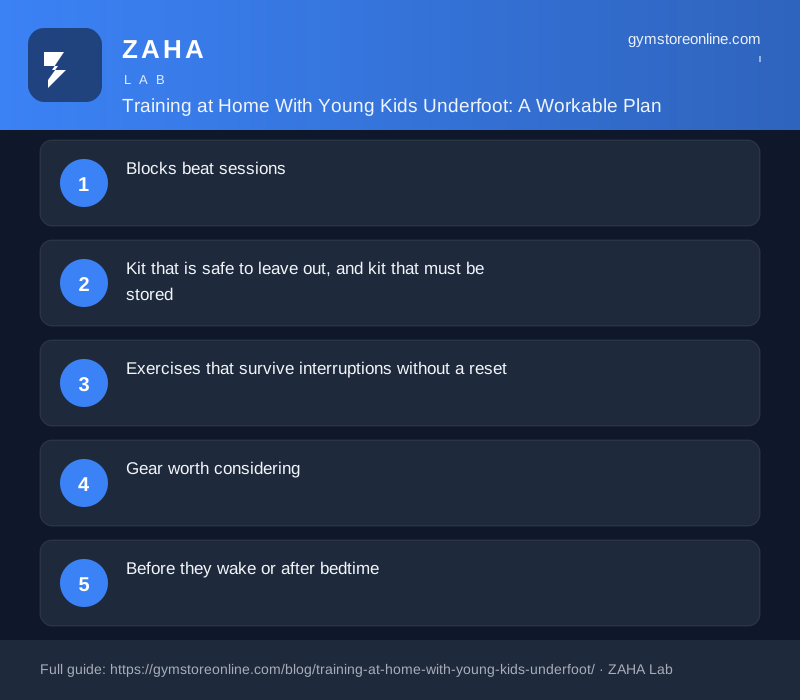
Blocks beat sessions
Forget the idea of one unbroken workout. Three 8-minute blocks spread across a morning deliver roughly the same weekly volume as a single 25-minute session, if you hit them consistently. The key difference: an 8-minute block can be paused after any exercise without losing a warm-up investment.
Structure each block around one movement pattern: a push (press-ups, band presses), a pull (band rows, suspension trainer rows), or a hinge (hip hinges, banded good mornings). Rotate across the day, or across the week. Six blocks of 8 minutes adds up to 48 minutes of actual training. Most people who wait for the perfect window never get there.
Kit that is safe to leave out, and kit that must be stored
Resistance bands can stay on a hook by the door: light, edge-free, and harmless if a child picks one up. An exercise mat stacked against a wall is equally safe. These two items need no special storage.
Dumbbells and weight plates are a different matter. A 10 kg dumbbell dropped on a toddler's foot causes a serious injury. Store them in a locked cupboard, a garage with a bolt fitted above child height, or a purpose-built rack with a securing bar. Do not rely on being careful alone. Interruptions arrive precisely when attention is divided.
Kettlebells need the same treatment as dumbbells. Doorframe pull-up bars that rely on pressure should come down when training ends, because a child can dislodge one with a single tug.
Exercises that survive interruptions without a reset
The movements below require no equipment setup and can be stopped mid-set without risk:
- Press-ups (flat, incline or deficit): stop anywhere in the set and walk away
- Banded squats and split squats: drop the band, deal with the situation, return
- Glute bridges and single-leg variations: floor-based, no bar or load overhead
- Band pull-aparts and face pulls: upper-back work that suits short, broken sets
- Dead bugs and hollow holds: core work that pauses cleanly at any point
Suspension trainer rows are equally good. Straps hanging from a door anchor stay put between sets without creating a hazard, provided the door remains closed. For a full guide to structuring these into a plan, see these resistance band workouts.
Gear worth considering
A compact, flexible kit collection suits a family home far better than a fixed rack of plates:
- A resistance bands set covers pulls, presses, squats and hinges, stores in a single drawer, and poses no injury risk if a child picks one up.
- An all-in-one suspension trainer attaches to a door anchor and takes under 10 seconds to remove when training ends.
- An extra-thick 10 mm exercise mat protects both the floor and your joints during floor work, and folds flat against a wall when not in use.
For a broader look at equipping your space, browse Home Gym Equipment at GymStoreOnline.
Before they wake or after bedtime
Early morning, before 6 am, gives genuine uninterrupted time. The practical limit is sleep debt. One or two early sessions per week is sustainable for most parents of under-threes. Every day is not.
Post-bedtime training works well for lower-intensity blocks: band work, mobility, and core. Avoid heavy sessions after 9 pm if sleep quality matters to you. The effect of elevated evening cortisol on sleep onset is well documented, even if the precise threshold varies between people. For more on fitting all of this into a working week, see these workout routines for busy adults.
Realistic weekly volume
Two to three strength-focused sessions per week, each built from two or three 8-minute blocks, is enough to maintain and modestly build strength for a healthy adult. That comes out to six to nine blocks weekly, covering push, pull, and lower-body patterns. Progress comes from adding one rep or a slightly heavier band over several weeks. Long sessions are not the variable that matters here.
Track it simply. A notes app, a whiteboard, or a piece of paper on the fridge all work. No periodisation spreadsheet needed. You just need to know whether you did more than last week.
Frequently asked questions
Can I train with my children in the room?
Yes, for low-risk exercises such as press-ups, band work and core movements. Keep heavy, free-standing equipment such as dumbbells and kettlebells stored away and only bring them out when the children are supervised elsewhere. Floor-based bodyweight work is generally safe to do alongside toddlers who are awake and moving around.
How do I store dumbbells safely with young children at home?
A locked cupboard or a garage with a bolt positioned above child height are the two most practical options for most UK homes. Relying on a high shelf is less reliable than a physical lock, as curious children often find ways to climb. Purpose-built dumbbell racks with a securing bar add an extra layer of protection.
Is training two or three times a week enough to build strength?
For a healthy adult following a consistent programme, two to three sessions per week is sufficient to build strength gradually over months. The research base around resistance training generally supports this frequency for beginners and intermediates. Consistency across weeks matters far more than the number of sets in any individual session.