
YOLEO Adjustable Weight Bench for Home Gym, ENISO-Certified 375KG, 98% Pre-Assembled, Foldable G
£79.99
View on Amazon →
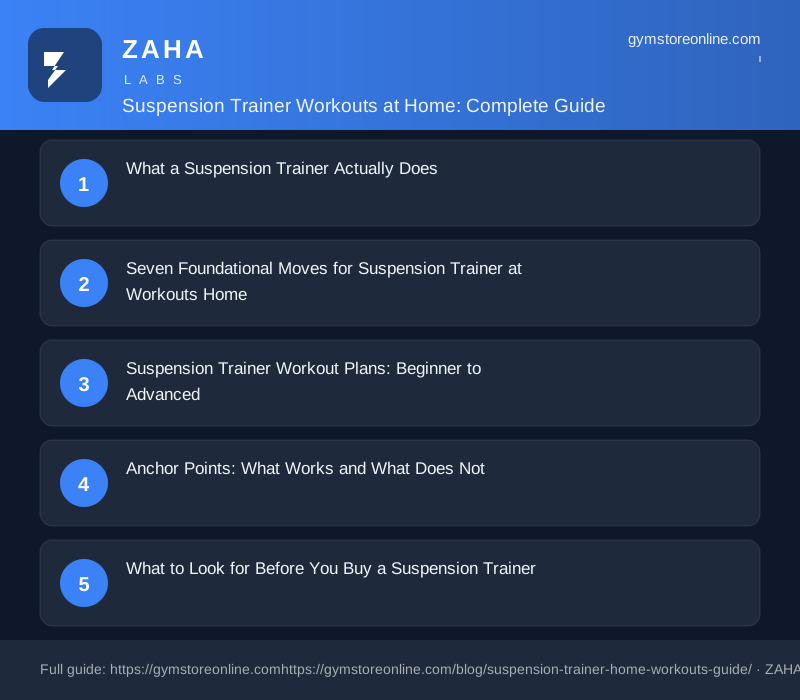
Published 17 September 2026 · updated 2026-09-17 · by GymStoreOnline
A full-body workout in under a square metre of floor space sounds like a marketing claim. Suspension trainer workouts at home prove it is simply physics: two adjustable straps, one solid anchor point, and your bodyweight deliver enough resistance to build genuine strength at any fitness level.
A single trainer covers push, pull, hinge, squat, and core patterns — making it one of the most cost-effective pieces of home-gym kit available. Anchor it to a door frame, overhead beam, or pull-up bar, adjust strap length to shift difficulty, and you have a complete session without the footprint or price tag of a cable machine.
A suspension trainer is a pair of webbing straps — usually nylon or reinforced polyester — with ergonomic handles and foot cradles at each end. You fix one end to an overhead anchor and use the handles or cradles to perform exercises that challenge your muscles through instability.
That instability is the mechanism. Because the straps move freely, your core, shoulders, and hips must stabilise every rep, recruiting more muscle fibres than a fixed-path machine would. Load is controlled entirely by body angle: lean further from the anchor and a greater percentage of bodyweight is placed on the target muscle. Lean less, and the same movement becomes accessible to complete beginners. There is no weight stack to set and no machine to adjust — just you and the angle.
These movements cover every major pattern and can be scaled from beginner to advanced by adjusting strap length and body angle alone — no additional kit needed.
Chest press — Face away from the anchor, hold both handles, and press out at chest height. The steeper the body angle (closer to horizontal), the harder the press. Beginners can start nearly upright and progress the angle over several weeks.
Suspended push-up — Feet in the cradles, hands on the floor. The free movement of the handles adds significant rotational instability compared to a standard push-up and activates far more shoulder-stabilising musculature.
Inverted row — Face the anchor, lean back, and pull your chest up to the handles. Often the first effective pulling movement beginners can manage without a dedicated pull-up bar. Straighten the body angle progressively to increase difficulty over time.
Single-arm row — One handle, neutral grip. Develops anti-rotation strength that carries directly into overhead pressing and loaded carry movements.
Suspension squat — Hold both handles and sit back into depth while the straps support balance. Useful for learning squat mechanics and building the hip mobility to reach full depth before loading a barbell.
Hamstring curl — Lie on the floor with heels in the cradles, bridge the hips up, then curl heels toward the glutes. A demanding posterior-chain exercise that requires no floor space beyond body length.
Bulgarian split squat — Rear foot in the cradle, front foot flat on the floor. One of the most effective single-leg exercises in any programme, matching the challenge of a loaded goblet squat at intermediate body angles.
| Level | Sessions per week | Primary focus | Typical session length |
|---|---|---|---|
| Beginner | 2–3 | Motor control, basic patterns | 25–35 min |
| Intermediate | 3–4 | Volume, tempo, unilateral work | 40–50 min |
| Advanced | 4–5 | Steep angles, plyometrics, complexes | 50–65 min |
Beginner session (3 rounds, 90 sec rest between rounds):
Intermediate session (4 rounds, 60 sec rest):
Progress by changing the strap length and body angle rather than swapping exercises. Photograph your setup angle each session so you can replicate the load accurately — this is how you apply progressive overload without a weight stack. A two-degree steeper angle is a meaningful increase in difficulty; do not underestimate it.
Most suspension trainers ship with a door anchor — a padded loop that sits over the top of a closed interior door. It handles pulling, pressing, and core movements well for the majority of users training at moderate body angles.
A door anchor is designed for controlled static loading, not dynamic swinging or explosive plyometric movements. Always check the stated maximum load rating before use, and never fit one to a hollow-core door — these are standard in most UK flats and cannot handle the shear forces a suspension trainer places on the frame. For heavier users or advanced work, a wall-mounted bracket fixed to a structural stud, a solid overhead beam, or a pull-up bar set into a door frame with appropriately rated fixings is significantly safer.
For ceiling joists or exposed beams, use a carabiner rated to at least 5 kN — the rating is printed on the gate sleeve of any fitness-grade carabiner. Test every anchor with a firm, controlled static hang before your first dynamic movement on it.
Not all trainers are built to the same standard. Run through this checklist before adding one to your basket:
A well-made suspension trainer packs to roughly 30 × 15 cm and fits inside a small rucksack. If the trainer ships with a carry bag, you can anchor it to a tree branch, a fence post, or a hotel fitness-room rack with no extra equipment. It is the one piece of home-gym kit that genuinely goes wherever you do — something no bench or barbell can claim.
A suspension trainer covers bodyweight-based instability work comprehensively. Once you want to add progressively heavier bilateral loading — barbell bench press, overhead press, loaded squats — you will need a stable bench, and eventually a rack. The two setups complement each other well: the trainer handles instability, unilateral work, and core loading; the bench and rack handle heavy compound progression.
For a bench that covers the full range of pressing angles, the YOLEO Adjustable Weight Bench (£69.99, 4.6 stars) offers 84–90 position combinations across incline, decline, and flat settings and arrives 98% pre-assembled. It carries an ASTM certification to 300–375 kg, meaning the rating is set by an independent standard rather than self-declared — relevant if multiple users of different weights will share the bench. For a lower upfront outlay, the OZE SPORTS Adjustable Weight Bench (£39.99, 4.5 stars) covers incline, decline, and flat positions in a foldable frame that stores flat when not in use, a practical option for smaller spaces.
If you want to add a rack alongside, the TOTEBOX Adjustable Squat Rack (£56.99, 4.6 stars) includes a push-up bracket, spotter arms, and a dipping bar attachment — covering pressing, dipping, and pull-up movements from a single structure. Many users anchor their suspension trainer to the same overhead bar on the rack, making it a dual-purpose set-up with no extra floor space required. For a more comprehensive combined solution, the YOLEO 400–900KG ASTM-Certified All in One Weight Bench Set (£99.99, 4.6 stars) integrates a bench press with rack, leg extension, and leg curl fixture, giving you compound and isolation movements without multiple separate purchases.
Every product linked on GymStoreOnline passes the same filter before we reference it:
We do not accept payment to alter rankings. All links go to live listings so the price and availability you see is current at the time of clicking.
A suspension trainer is a strong fit if you:
Consider other kit first if:
Suspension trainer workouts at home occupy a genuinely useful space: low cost, low footprint, and wide enough in scope to carry most people through the first year of consistent home training with measurable improvements in core stability, shoulder control, and single-leg strength.


Suspension trainers build muscle when used with genuine progressive overload — specifically by steepening your body angle over time to increase the percentage of bodyweight you are lifting. The instability also activates stabilising muscles that fixed machines miss. For most training goals up to intermediate level, a suspension trainer delivers comparable adaptations to a cable machine at a fraction of the cost. Beyond intermediate strength, adding barbell loading will eventually outpace bodyweight-only training.
Most suspension trainer exercises work from an anchor set between 2.0 and 2.4 metres above floor level — roughly the height of a standard UK interior door frame. Overhead movements such as pikes benefit from a slightly higher anchor, ideally above 2.1 metres. Always check the instruction booklet for your specific trainer, as strap length varies between models. Test every anchor with a controlled static hang before loading it with dynamic movement.
Yes — the two fill different gaps. A bench supports pressing and rowing with added barbell or dumbbell load but offers nothing for single-leg balance, rotational core work, or instability-based stabilisation. A suspension trainer covers exactly those areas. If your bench setup already has an overhead pull-up bar or rack structure, you can often anchor the suspension trainer to the same point, giving you a dual-purpose set-up without any extra floor space.
Yes. A door anchor — the padded loop included with most trainers — fits over any solid-core interior door and handles the majority of exercises safely. The exceptions are explosive or very heavily loaded movements, which place greater shear force on the frame. For those, a wall-mounted bracket fixed to a structural stud is the safer option. Check your door is solid-core first; hollow-core doors are standard in most UK flats and are not suitable for suspension trainer use.
As an Amazon Associate we earn from qualifying purchases. Prices and availability are accurate as of the date shown and are subject to change — the price on Amazon at checkout is the one that applies.
Find the best adjustable bench for ab and core workouts at home. UK guide covering angles, load ratings and picks under £100 for e
Everything you need to choose the best adjustable dumbbells for home workouts: weight range, locking mechanisms, build quality and
Build your home barbell and weight plate setup right: what to look for in bars, plates, squat racks and benches. Real specs, UK pr