
ELIRAVO Women's High Waisted Cycling Shorts, 5"/8" Anti Chafing Gym Lycra Shorts, Butt Lifting N
£12.99
View on Amazon →
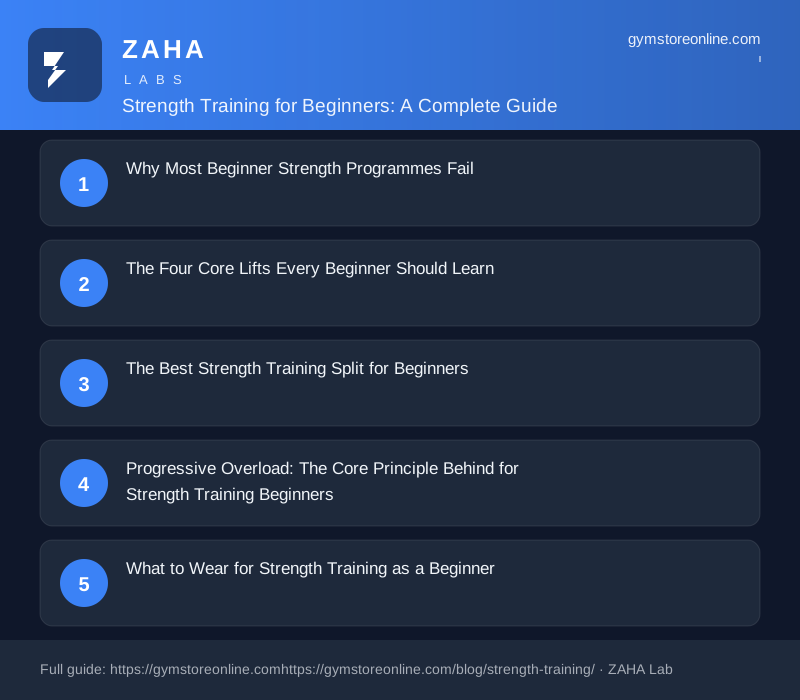
Published 17 September 2026 · updated 2026-09-17 · by GymStoreOnline
Strength training for beginners works best when the programme is simple enough to repeat and honest enough to measure. Three compound lifts, two to three sessions a week, and a rule that you only add weight when form is controlled — that framework outperforms anything more elaborate for the first six months.
Beginners are routinely sold on variety — circuits, HIIT hybrids, a different exercise every session. The logic sounds reasonable but it fails for one reason: you cannot track progress if the programme is always changing. Visible weight on the bar, measurable from session to session, is what keeps people training past the first month.
Effective strength training for beginners means repeating the same compound lifts until the nervous system learns the movement pattern, the joints adapt, and the weight increases week after week. Swapping exercises before that adaptation is complete resets the clock every time.
The second common failure is starting too heavy. If you cannot complete five reps with clean form, the weight is wrong. Starting light feels counterintuitive but it protects joints through the adaptation phase and produces faster long-term progress.
These four movements train the whole body efficiently and appear in virtually every evidence-based beginner programme. Master them before adding anything else.
| Lift | Primary Muscles | Why It Belongs in a Beginner Programme |
|---|---|---|
| Squat (barbell or goblet) | Quads, glutes, core | Largest lower-body stimulus; teaches bracing and joint tracking |
| Deadlift (conventional or Romanian) | Hamstrings, glutes, lower back | Highest total muscle recruitment of any single lift |
| Bench Press (barbell or dumbbell) | Chest, triceps, front delt | Foundational horizontal push pattern |
| Bent-Over Row or Cable Row | Lats, rhomboids, biceps | Balances push volume and builds back thickness |
Add overhead press as a fifth movement once the first four feel natural. Isolation work — curls, lateral raises, calf raises — is worth adding later as accessories. Adding them too early spreads recovery capacity thin without meaningful return.
Hold a dumbbell or kettlebell at chest height and squat — this teaches you to sit into the movement and keep your torso upright before you load a barbell across your back. Two to four weeks here makes the transition to barbell squatting noticeably cleaner and easier on the lower back.
Two to three sessions per week is the optimal starting frequency. Compound lifts tax the central nervous system as well as the muscles, and 48–72 hours of recovery between sessions is not optional — training more often does not accelerate beginner gains, it raises injury risk.
A full-body template that works for most beginners:
Alternate A and B on non-consecutive days. Three sets of five reps per lift is sufficient. Add 2.5 kg to upper-body lifts and 5 kg to lower-body lifts each session when all sets are completed with clean form. When a weight stalls two sessions in a row, drop 10 % and build again.
Resist adding exercises. The programme works because of repeated exposure and incremental loading, not its complexity.
Progressive overload means placing slightly more demand on the muscle than it faced last session. For beginners this is as simple as adding a small amount of weight whenever the current load feels controlled. The body at this stage is highly adaptive — even modest weekly increases compound into significant strength gains across a six-month block.
Log every lift, every set, every rep. Without a record you cannot distinguish progress from plateau, and plateaus happen without obvious warning. Rest two minutes between compound sets so quality holds across all three rather than fading on the third.
The first six to eight weeks may feel almost too easy on some lifts. That is by design. The nervous system is adapting during this phase, and pushing beyond the prescribed load before that adaptation completes is the most common cause of early overuse injuries.
Kit will not add weight to your lifts, but the wrong kit makes every session worse. Squatting in shorts that ride up mid-rep or deadlifting in leggings that slip breaks concentration at the worst possible moment.
For women, high-waisted cycling shorts are the near-universal choice in the weight room. They stay in place through the full range of a squat or deadlift, provide light compression, and the high waistband keeps coverage during core work and hip hinge movements.
Fabric that looks opaque under normal lighting can become sheer under the overhead fluorescents in most gym weight rooms, particularly when stretched in a deep squat. Hold the shorts up to a bright light source before your first session — if you can clearly see your hand through the fabric, they will be transparent when worn. Listings that explicitly call out non-see-through construction are worth the extra few pounds over alternatives that don't address the point.
Before buying, check these four things:
The ELIRAVO Women's High Waisted Cycling Shorts (£12.99, 4.8 stars) are listed as anti-chafing and non-see-through, available in 5-inch and 8-inch inseam lengths — useful if you want to confirm the right fit before committing to a length. The anti-chafing construction is specifically relevant for deadlift work, where fabric moves repeatedly against the inner thigh across multiple sets.
The Runhit Womens Cycling Shorts (£9.99, 4.7 stars) include two side pockets and tummy control compression in a 6-inch inseam. Practical if you prefer to keep a phone or locker key on you between sets rather than leaving it on a bench.
The JOYSPELS Women's High Waisted Cycling Shorts (£14.99, 4.6 stars) use 4-way stretch fabric and explicitly state the non-see-through construction in the listing — worth checking given how variable this feature is between brands at the same price tier.
For a premium option, the CRZ YOGA Butterluxe Biker Shorts (£18.00, 4.6 stars) use the brand's Butterluxe fabric across three inseam lengths — 3-inch, 5-inch, and 8-inch — with a notably soft hand feel and gentle compression that holds its shape through a full training block. The choice of inseam lengths makes them adaptable across both lifting and conditioning sessions.
For men, the Runhit Men's Running Leggings (from £6.35 for a single pair, also available in a three-pack) include pockets and a thermal base-layer construction — practical for training in autumn and winter or in gyms where the air conditioning runs cold.
Every product listed meets a minimum 4.4-star rating. We prioritised items with specific functional callouts in their titles — anti-chafing construction, non-see-through fabric, 4-way stretch — because those are the features most likely to fail in budget gym kit. All options are priced under £20. We do not list items where the functional claims cannot be verified from the product listing itself, and we do not rank options against each other — the right choice depends on inseam preference, pocket requirements, and fabric priorities.
Good fit: Anyone with no previous barbell experience, returning lifters after a long break, and people moving from cardio-only training who want to build muscle. The two-to-three-day structure suits irregular schedules — missing one session in a week does not derail progress at this stage.
Proceed with care: Anyone with a lower-back injury, knee pathology, or shoulder impingement should seek physiotherapy clearance before starting barbell work. Goblet squats and Romanian deadlifts with dumbbells are lower-risk entry points if you are uncertain about joint readiness — modifications exist for all four core lifts but require individual assessment.
Stop and consult first: Acute joint pain during any lift is a stop signal, not a push-through signal. Beginners often cannot distinguish normal training discomfort from genuine joint pain — end the session and get a professional opinion before the next one.
Skipping the warm-up. Two sets of the same movement at roughly 50 % of working weight takes under five minutes. Treat it as part of the session, not optional preparation.
Ego loading. Adding too much weight too quickly is the most common cause of beginner stalls and overuse injuries. The programme should feel almost too easy in the first two to three weeks — the nervous system is adapting, not the muscle yet.
Inconsistent squat depth. Hip crease at or below the top of the knee is the target from session one. Partial squats become a habit that limits long-term progress and loads the knee in a less favourable position as the bar gets heavier.
Neglecting sleep and protein. Muscle is built during recovery, not during the session. Seven to nine hours of sleep and roughly 1.6 g of protein per kg of bodyweight per day are the two recovery variables with the most consistent evidence behind them. Everything else at beginner stage is marginal by comparison.


Two to three sessions per week is the optimal starting frequency. Compound lifts tax the central nervous system as well as the muscles, and the body needs 48–72 hours between sessions to recover and adapt. Training more often at this stage does not speed up progress — it increases the likelihood of overuse injury. After three to four months of consistent training, adding a fourth session becomes a reasonable next step.
High-waisted cycling shorts are the most practical choice for lifting. They stay in place through squats and deadlifts, provide light compression, and the wide waistband keeps coverage during core work. Look for non-see-through fabric, a 6–8 inch inseam for compound movements, and side pockets if you carry a phone or key. Options like the ELIRAVO Women's High Waisted Cycling Shorts or the JOYSPELS Women's High Waisted Cycling Shorts cover all of these at under £15.
Most beginners notice strength improvements within two to four weeks — this is neural adaptation rather than muscle growth. Visible muscle changes typically appear after eight to twelve weeks of consistent training. The single most important variable is turning up: two sessions a week for twelve consecutive weeks outperforms sporadic intensive training every time. Logging your lifts makes early progress visible even before the mirror reflects it.
A gym gives access to barbells, squat racks, and incremental plate weights that are difficult to replicate at home without significant upfront cost. For the core compound movements — especially barbell squats and deadlifts — a gym is the most practical starting point. If home training is your only option, dumbbell variations of all four core lifts exist and produce solid results at beginner level, though progression slows once you outgrow the available weight range.
As an Amazon Associate we earn from qualifying purchases. Prices and availability are accurate as of the date shown and are subject to change — the price on Amazon at checkout is the one that applies.
Find the best adjustable bench for ab and core workouts at home. UK guide covering angles, load ratings and picks under £100 for e
Everything you need to choose the best adjustable dumbbells for home workouts: weight range, locking mechanisms, build quality and
Build your home barbell and weight plate setup right: what to look for in bars, plates, squat racks and benches. Real specs, UK pr