How to Stay Consistent With Home Gym Training (Without Burning Out in February)
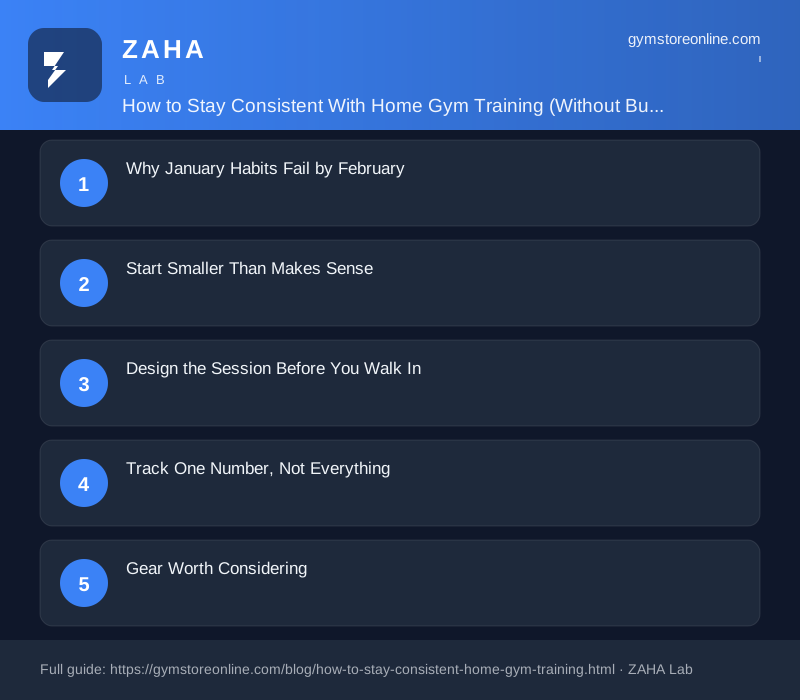
By mid-February, most people who signed up for a gym in January have already quit. Staying consistent with home gym training sidesteps the January rush, removes the commute, and cuts friction to near zero. Train three times a week for eight consecutive weeks and you cross from willpower into routine.
Why January Habits Fail by February
The problem is not willpower. Research published in the British Journal of Health Psychology found that forming a stable exercise habit takes 66 days on average, not the 21 days most people expect. January gym-goers often start at maximum effort: five sessions a week, new trainers, calorie-tracked meals. Twelve days in, life intervenes. One missed session becomes two. The all-or-nothing framing turns a small stumble into full abandonment.
A home gym changes the equation because friction drops to near zero. The walk to your spare room is not a 25-minute drive to a leisure centre. Lower barriers mean you show up on the days you do not feel like it, and those are the sessions that actually build the habit.
Research on exercise adherence consistently finds that people who train at home are more likely to hit their weekly targets than those who depend on travelling to a facility. Every additional step between you and a workout is a chance to skip it.
Start Smaller Than Makes Sense
A 20-minute session four times a week will outperform an hour-long session once a week over six months. Research consistently finds that training frequency is a stronger predictor of long-term adherence than session duration. Your body adapts to shorter, more frequent stimulus more efficiently than long, infrequent ones.
Set a minimum effective dose. If you are new to home training, that might be a 15-minute full-body circuit on Monday, Wednesday, and Friday. Nothing more. Once you hit eight consecutive weeks without missing more than one session, add 10 minutes. Never add time while you are still fighting to show up.
Design the Session Before You Walk In
Decision fatigue is real. Standing in your home gym wondering what to do is already a reason to quit. Write the workout the night before. Keep it short. A reliable structure for beginners: one pushing movement, one pulling movement, one hinge, one carry. Intermediate trainers can add a second exercise per pattern, nothing more.
Pin the session to a fixed time. Studies on exercise adherence find that people who train at the same time each day are significantly more likely to maintain the habit at 12 months than those who leave the time open. Mornings work well for most people because willpower has not yet been spent on competing demands. If mornings do not suit you, the same logic applies to any slot you genuinely protect.
A five-minute warm-up at the start of every session also reduces the psychological barrier. If you commit to only five minutes before reassessing, you almost always continue. Almost no one stops after a warm-up.
Track One Number, Not Everything
Fitness apps and wearables can make tracking feel like a second job. Pick one metric and follow it for 12 weeks. For strength training, that is usually a lift you do every session: a goblet squat or a dumbbell row. Write the weight and reps in a note on your phone after each session. A clear upward trend over three months beats a dashboard full of data you barely read.
Logging sessions also creates a visual chain. Miss a day and you break it. B.J. Fogg's research at Stanford found that small completion triggers, including simply ticking a box, release dopamine and reinforce the neural pathway. You are rewiring your brain each time you record a finished session.
Make the record visible. Print a simple 12-week grid and pin it above your training space. A chain of 30 consecutive ticked sessions looks different to the eye than a number buried in an app. It is harder to break something you can see.
Gear Worth Considering
You do not need a full commercial setup. Three pieces of kit cover the majority of home workouts.
- [ADJUSTABLE DUMBBELL SET 5-32.5KG]. A set that dials from 5 kg to 32.5 kg covers dozens of movements without buying separate fixed weights. Available on Amazon UK in several configurations.
- [DOORFRAME PULL-UP BAR]. Fits a standard UK door frame and adds a pulling movement most people cannot replicate without one. Filter for a bar rated to at least 100 kg on Amazon UK.
- [LOOPED RESISTANCE BAND SET, 5 BANDS]. Compact, low-cost, and useful for warm-ups, shoulder mobility, and accessory movements. Five varying resistances cover everything from light activation work to heavy hip exercises.
When Motivation Disappears
Motivation disappears. Plan for it. Relying on inspiration to carry your sessions is why most people quit before March. Discipline means showing up when motivation is absent, and discipline is built exactly like strength: with repetition over time.
Use the two-session rule. Never miss two sessions in a row. One missed session is life. Two missed sessions is the start of a bad new habit. If you miss Monday, Tuesday is non-negotiable.
Environment design reinforces the rule. Put your training clothes next to your bed the night before. Leave your resistance bands on the floor of your home gym. Make starting the path of least resistance. Starting is the hard part. Once you are three minutes into a warm-up, stopping costs more effort than continuing.
Frequently Asked Questions
How many times a week should I train at home to see results?
Three sessions a week is the minimum for meaningful strength or fitness progress in most beginners. Systematic reviews on training frequency find that three to four weekly sessions produce 80 to 90 percent of the results seen with five or more, while cutting dropout rates significantly.
What if I miss a week entirely?
One week off will not undo meaningful progress. Muscle memory research shows that strength returns faster the second time than it took to build originally. Return on the first available day and do not treat the gap as permission for more time off.
Do I need expensive equipment to train consistently?
No. Bodyweight training with a pull-up bar and a resistance band set covers three of the four fundamental movement patterns. A basic adjustable dumbbell set completes the picture. Total outlay can stay under 150 pounds for a setup that supports years of serious training.
How long before training feels automatic?
The average in peer-reviewed literature is 66 days, but individual variation is wide. Some people report habits forming in 30 days; others take more than 100. What matters most is showing up consistently until it clicks.