How much protein do UK home gym users actually need?
22 October 2026 · GymStore Online
Most UK home gym users are not short of training advice; they are short of a straight answer on protein. The honest version takes about two minutes of arithmetic and a bit of habit-building, and it does not require a tracking app or a £45 tub of anything fancy. Here is how to work out your number, hit it with supermarket food, and spend sensibly on Amazon UK.
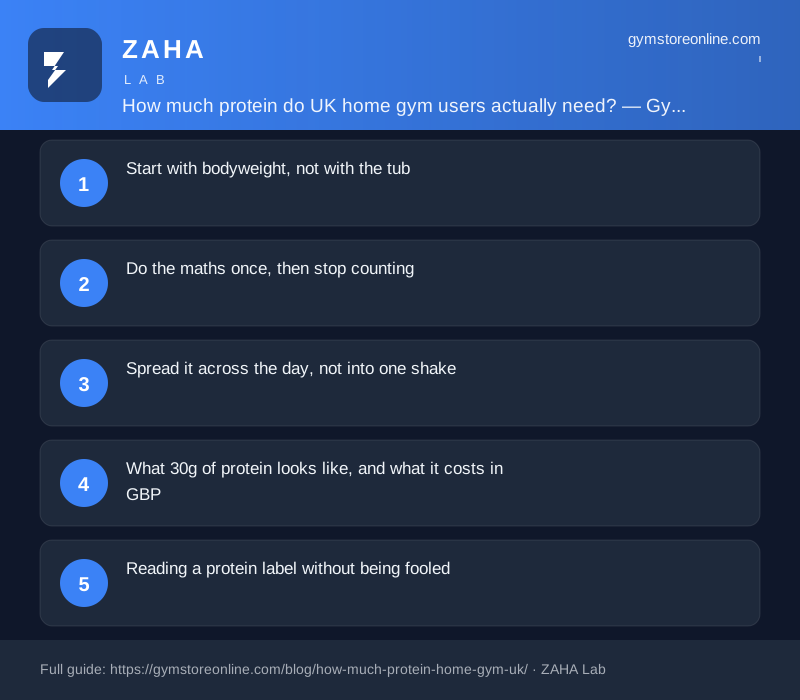
Start with bodyweight, not with the tub
The UK reference nutrient intake for protein is 0.75g per kilogram of bodyweight per day for adults. That figure is set to prevent deficiency in the general population, and it assumes very little demanding physical activity. If you are squatting, pressing and rowing in a garage three or four times a week, treat it as a floor rather than a target.
Sports nutrition guidance for people doing regular resistance training usually lands in a range of roughly 1.4 to 2.0g per kilogram per day. For a 75kg lifter that is about 105g to 150g; for a 90kg lifter, roughly 126g to 180g. Those numbers sound large next to a round of toast, which is why so many home gym users under-eat protein without realising it.
Where you sit inside that range matters less than being consistent. Somebody training three times a week and holding weight can sit near the bottom. Somebody dieting hard to lose fat should sit towards the top, because protein is the macronutrient that helps protect muscle while calories are low. Older trainees, and anyone eating mostly plant protein, generally do better nearer the upper end too.
Do the maths once, then stop counting
Take your bodyweight in kilograms, multiply by 1.6, and you have a sensible working number for most home gym training. A 70kg person gets 112g; an 85kg person gets 136g. Round it to the nearest ten, write it on a note for the fridge or save it in your phone, and stop recalibrating it every week.
Use total bodyweight rather than trying to estimate lean mass unless you are carrying a lot of excess fat, in which case use a realistic goal weight instead. Precision here is a distraction. Hitting 130g on most days beats agonising over whether the true figure is 128g or 134g, and it is far more useful than a calculator that produces a target you never actually reach.
The practical version is to anchor the day around three meals at 35g to 45g each, plus one smaller protein snack. That is four eating occasions, each big enough to matter, and after a fortnight you can drop the weighing and just eyeball portion sizes.
Spread it across the day, not into one shake
Research on muscle protein synthesis points to a per-meal dose in the region of 20g to 40g of good-quality protein for most adults, with diminishing returns above that. Three or four of those doses across the day is a better pattern than one enormous evening meal, simply because the total gets used rather than burned off.
In practice, UK eating habits make breakfast the weak point. Cereal and toast might deliver 8g to 12g. Swapping to three eggs on one slice of toast, or a bowl of Greek yogurt with a scoop of whey stirred through, takes that meal to 30g or more without any extra cooking skill.
Around training, the day's total matters far more than the famous thirty-minute window. A meal or shake within a couple of hours either side of your session is perfectly adequate. If you train first thing before work, a shake is the easiest way to get protein in without forcing down a full meal at 6am.
- Three large eggs, roughly 19g, cooked in five minutes
- 250g of Greek yogurt, roughly 25g, plus a scoop of whey if needed
- A 30g scoop of whey in water, typically 23g to 24g
- Two slices of wholemeal toast with peanut butter, about 12g — useful, but not a meal on its own
What 30g of protein looks like, and what it costs in GBP
Real-food reference points help more than any app. A 150g raw chicken breast is about 35g of protein. Three large eggs are around 19g. A 250g pot of Greek yogurt is roughly 25g, a drained 145g tin of tuna about 30g, 250ml of semi-skimmed milk about 9g, and 100g of cooked red lentils around 9g. A standard 30g scoop of whey concentrate is typically 23g to 24g.
Cost per 25g of protein, at typical UK supermarket and Amazon prices, varies enormously. Whey powder bought in a 2kg tub usually works out somewhere around 60p to 90p. Three eggs cost roughly 60p to 75p for a similar amount. Chicken breast is closer to £1.20 to £1.60, tinned tuna around 80p to £1.10, and lentils or milk come in well under 40p. Treat all of that as a rough guide and check current prices before you commit to a bulk buy.
The sensible conclusion is not that powder replaces food. It is that powder and dairy make the target affordable and easy to hit on busy days, while chicken, fish, eggs and pulses do the heavy lifting for fullness and micronutrients. Most people end up with a mix of both, and that is fine.
Reading a protein label without being fooled
Ignore the front of the tub and go straight to the nutritional panel. What matters is protein per 100g of powder, not per scoop, because scoop sizes vary from 25g to 40g between brands. A decent whey concentrate sits somewhere around 70g to 80g of protein per 100g; a whey isolate is usually higher, in the low to mid 80s.
Watch for amino spiking. Some powders add free glycine, taurine or creatine, which inflates the nitrogen-based test used to measure protein without adding complete protein. A label showing a full amino acid profile, or stating the percentage of protein coming from whey or milk, is a better sign than a big headline number on the front.
If you are lactose-sensitive, a whey isolate or a blend with added lactase is usually easier than a cheap concentrate. Plant-based buyers should look for a pea and rice blend rather than a single source, because the amino acid profiles complement each other. None of this needs to be expensive; the mid-priced tubs are usually perfectly adequate.
Adjusting for cutting, bulking and maintenance
If you are holding weight and training for general strength, 1.4g to 1.6g per kilogram is plenty. In a calorie deficit, push towards 1.8g to 2.0g per kilogram, because that is the range that best supports holding on to muscle while the scales move down. In a surplus, 1.6g to 2.0g is more than enough; there is no extra benefit in going higher.
In a deficit, protein earns its place because it is the most filling macronutrient per calorie. Build meals around a protein source first, then add vegetables for volume, then rice, potatoes or bread with whatever calories are left. Doing it in that order is far easier than trying to subtract foods later.
Older trainees and anyone eating mostly plant-based should aim towards the upper end of the range and spread intake more evenly across the day. Plant proteins are generally lower in leucine per gram, so a larger total and a mix of sources, such as soy, pea and wheat together, gets you to much the same place.
A worked day at roughly 145g of protein
The easiest way to see whether the target is realistic is to sketch a normal day rather than an ideal one. This example uses four sittings, supermarket ingredients, one powder and about fifteen minutes of cooking at each meal.
Swap the chicken for tofu, tempeh or a pea-protein mince and the numbers barely move. Swap the tuna for tinned salmon or sardines if you prefer them, and use a whey isolate in place of concentrate if dairy tends to sit heavily. The structure stays the same, which is the point.
If a day looks roughly like this three or four times a week and you train consistently, you are already doing the thing that matters. Nobody needs to hit the number perfectly every single day for it to count.
- Breakfast: 250g Greek yogurt, a 30g scoop of whey and a handful of berries — around 48g
- Lunch: two eggs and a 145g tin of tuna with rice or in a wholemeal sandwich — around 45g
- Dinner: 150g chicken breast with potatoes and vegetables — around 38g
- Snack: 250ml milk and a slice of cheese, or a second shake — around 15g to 20g
If you want to put the number into practice, start with a 2kg tub of whey, a decent shaker and a protein source you genuinely enjoy eating, then build the rest of the day around it. Have a look at the protein powders and home gym kit on GymStore Online, and sort the target out before you buy anything else.
Browse the full Supplements category for this kind of kit, and see the GymStore Online blog for more buying guides and training plans.