Home Gym Recovery and Mobility: How Sleep, Rest Days and Foam Rolling Build Muscle
Every kilogram of muscle you have ever gained was built during rest, not during training. Home gym recovery, covering sleep quality, foam rolling and rest days, is where adaptation actually happens. Training creates the stimulus. Recovery converts it into strength.
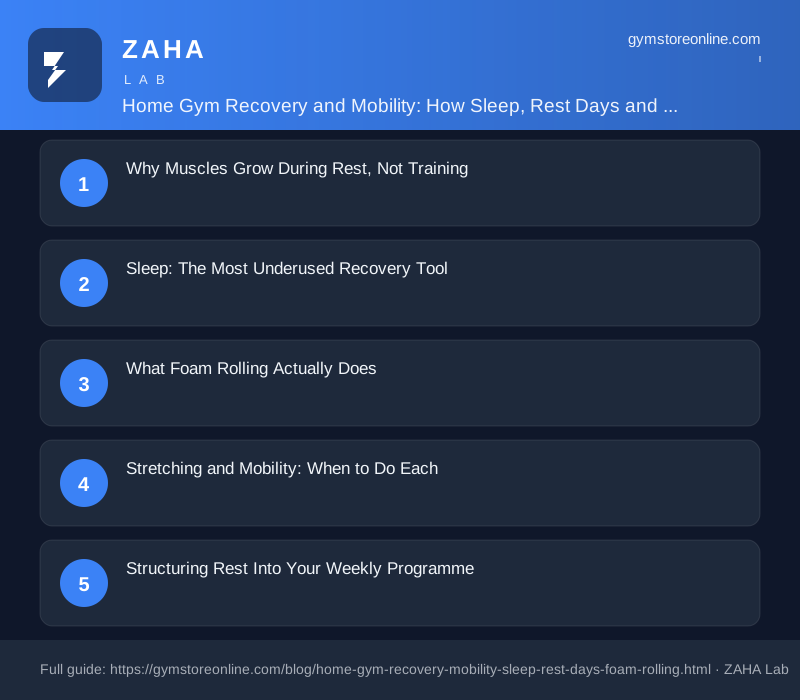
Why Muscles Grow During Rest, Not Training
Resistance training causes mechanical stress in muscle fibres. That stress triggers satellite cells to activate, multiply and fuse with damaged tissue. The process is called muscle protein synthesis, and it peaks 24 to 48 hours after a session, not during it.
A 2022 review in the Journal of Strength and Conditioning Research found that trainees who consistently under-recovered showed testosterone-to-cortisol ratios around 18 per cent lower than those with structured rest days, after just three weeks. That hormonal shift directly suppresses the anabolic signal that drives muscle growth.
Training without adequate rest is not discipline. It is a slow accumulation of damage without the repair cycle that makes it worthwhile.
Sleep: The Most Underused Recovery Tool
During slow-wave sleep, the pituitary gland releases growth hormone in pulses. That hormone drives muscle repair and body composition changes directly. A 2011 Stanford study on collegiate athletes found that cutting sleep from 8 hours to 6 hours reduces those pulses by roughly 20 per cent.
Keep your bedroom below 18 degrees Celsius. Core body temperature must drop for deep sleep to begin, and a cool room shortens the time it takes to get there. Avoid screens for 45 minutes before bed: blue light at 200 lux reduces melatonin production by up to 50 per cent.
If your home gym sessions run in the evening, finish training at least 90 minutes before sleep. Elevated adrenaline and core temperature after hard effort delay sleep onset, even when you feel subjectively tired.
What Foam Rolling Actually Does
Foam rolling does not break up scar tissue. Achieving that would require pressures far beyond what a foam roller generates against soft tissue. What rolling does do is reduce perceived muscle soreness in the 48 hours after training by 20 to 40 per cent, according to a 2015 meta-analysis in the International Journal of Sports Physical Therapy. It also temporarily improves joint range of motion, which makes it a useful pre-session tool.
Roll at roughly one inch per second. Spend 30 to 60 seconds per muscle group. When you find a tender spot, pause there rather than rolling over it repeatedly. A standard 90cm cylinder roller works for quads, hamstrings and the thoracic spine. A lacrosse ball gives more precise pressure on calves, glutes and the base of the foot.
Stretching and Mobility: When to Do Each
Static stretching genuinely increases range of motion over time. The problem is timing. A 2013 meta-analysis in the Scandinavian Journal of Medicine and Science in Sports found that static stretching immediately before lifting reduces force output by 5 to 8 per cent in the following 15 minutes. Save it for after training or for dedicated rest days.
Dynamic mobility is the correct pre-training warm-up: leg swings, hip circles, thoracic rotations. These take joints through their full range without impairing force production.
Two areas matter most for home gym users who also spend hours at a desk. Hip flexor tightness limits squat depth and causes anterior pelvic tilt. Thoracic stiffness restricts overhead pressing and deadlift posture. Ten minutes daily, split between a low lunge hip flexor hold (60 seconds per side) and a thoracic extension over a chair back, produces visible changes in range of motion within three to four weeks.
Structuring Rest Into Your Weekly Programme
Three to four training sessions per week, with at least one full rest day between lower-body sessions, outperforms daily training for most home gym trainees over any period longer than four weeks. Muscle protein synthesis needs time, and without it each session compounds fatigue rather than adaptation.
On the day after a hard session, active recovery beats passive rest for most people. A 20 to 30 minute walk or a low-intensity mobility circuit increases blood flow to recovering tissue without adding mechanical load. Hard effort on a designated rest day removes its purpose entirely.
Protein intake on rest days matters as much as on training days. Muscle protein synthesis continues for 24 to 48 hours post-session. Aim for 1.6 to 2.2 grams per kilogram of bodyweight daily, seven days a week, not only on training days.
One practical self-check: rate your readiness each morning on a scale of 1 to 10. A score consistently below 5 after a full night's sleep is a reliable signal that your programme needs less volume, not more determination.
Gear Worth Considering
- [HIGH-DENSITY FOAM ROLLER, 90CM]: The standard starting point for home recovery work. High-density foam holds its shape after months of daily use; budget versions compress within weeks and lose effectiveness. Well-reviewed options are available from [BRAND PLACEHOLDER] on Amazon UK.
- [TRIGGER POINT BALL 2-PACK]: Gives more targeted pressure than a roller for the calves, glutes, IT band and foot sole. Most packs include two firmness levels for different tissue depths. [BRAND PLACEHOLDER] options on Amazon UK typically come in under £15.
- [ENTRY-LEVEL PERCUSSIVE MASSAGE GUN]: Percussion devices apply rapid pressure cycles to muscle tissue and reduce soreness with roughly 2 minutes of application per muscle group. Look for [PRODUCT NAME] on Amazon UK; entry-level models typically fall between £30 and £60 and include multiple head attachments.
Frequently Asked Questions
How many rest days do I need each week?
Most home gym trainees need two to three rest days per week, spread to avoid consecutive lower-body sessions. Beginners typically need more. The clearest signal to add a rest day is declining strength or rep counts across consecutive sessions despite adequate sleep and nutrition: volume is outpacing recovery.
Should I foam roll before or after training?
Both are valid, but for different reasons. Before training, foam rolling temporarily improves joint range of motion as part of a warm-up. After training, it reduces delayed-onset muscle soreness over the following 48 hours. If time is short, prioritise rolling after the session.
Can I do light exercise on rest days?
Yes. Low-intensity movement, often called active recovery, supports rather than hinders recovery for most people. A 20 to 30 minute walk or a mobility circuit at low intensity increases blood flow without adding meaningful mechanical stress to recovering tissue.
Does stretching speed up muscle recovery?
Static stretching does not directly accelerate muscle repair. Its main benefit is improving long-term range of motion through consistent practice over several weeks. Where it contributes indirectly is by improving movement quality during training, which reduces the injury risk that forces unplanned rest periods.