Home Gym Injury Prevention: 5 Mistakes That Leave Solo Lifters Sidelined
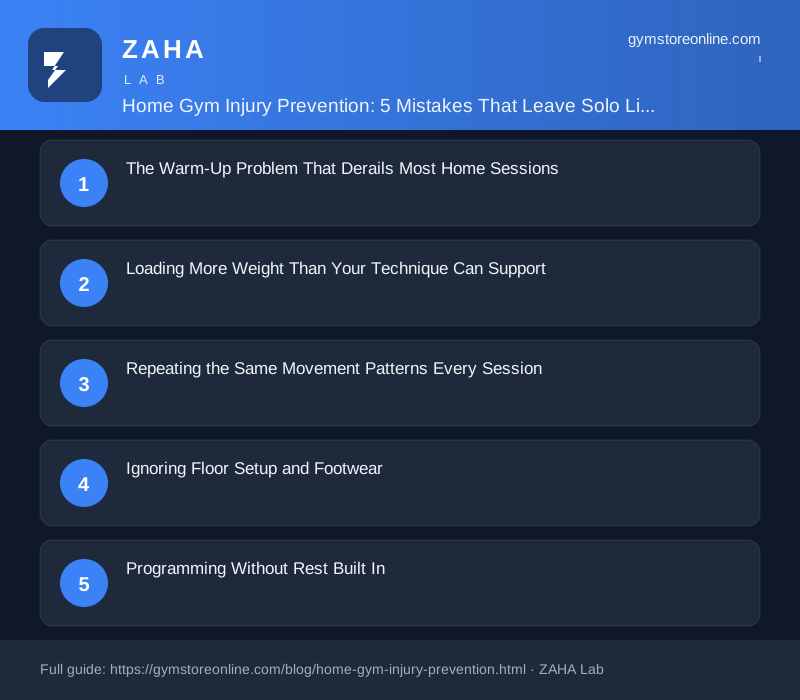
Nearly 40 percent of recreational strength trainers sustain an overuse or acute injury each year. Home gym users face extra risk: no coach watching form, no spotter, and equipment accessible at any hour when fatigue is already degrading technique. Home gym injury prevention comes down to five repeatable form checks and programming decisions most solo lifters skip in the first six months of training.
The Warm-Up Problem That Derails Most Home Sessions
A five-minute jog on the spot is not a warm-up for a heavy deadlift. General cardiovascular elevation is useful, but what you actually need before loading a barbell is tissue-specific preparation: hip mobility, thoracic extension, and a progressive loading ramp.
Exercise science consistently shows that athletes following structured dynamic warm-up protocols report 30 to 40 percent fewer lower-limb injuries over comparable training blocks. The reason is straightforward: dynamic movement raises muscle temperature, increases synovial fluid production in joints, and primes the neuromuscular patterns you are about to load under fatigue.
Practical rule: spend one minute of targeted mobility per major movement in that session. Squatting today? Add 90-90 hip stretches, ankle circles, and goblet squats at 40 percent of your working weight before touching anything heavier. Pressing? Try shoulder dislocations with a resistance band and two slow-descent push-up sets first.
Loading More Weight Than Your Technique Can Support
Without a coach watching from the side, it is easy to miss the moment when your hips shoot up early on a deadlift or your lower back rounds under a squat. The load keeps going up because the lift feels strong, right up until something gives.
Two adjustments fix most loading errors. First, film yourself from the side for at least two sessions per month. You do not need a coach to notice that your knees are caving inward or your bar path is drifting forward. Second, apply the 10 percent rule: never increase total weekly load by more than 10 percent from one week to the next. If you bench pressed 60 kg for three sets last week, your ceiling this week is 66 kg, not 80 kg.
Wrist and elbow pain during pressing is almost always a grip-width problem. Move your hands 2 cm narrower on the bar. The discomfort typically resolves within two sessions.
Repeating the Same Movement Patterns Every Session
Most home gym set-ups are limited. A barbell, a bench, and a pull-up bar cover the basics, but they also push you toward the same push-pull split week after week. Overuse injuries such as rotator cuff tendinopathy and patellar tendinitis develop when the same tissue is loaded at the same intensity without enough variation.
Add one unilateral exercise per session. Bulgarian split squats and single-leg Romanian deadlifts each shift the load distribution enough to give overworked muscles a relative rest while still accumulating training volume. Vary your grip width or stance width every four weeks. Small changes in angle determine which muscle fibres bear the primary load, and that rotation is often the difference between a tendon that recovers and one that becomes chronically irritated.
Ignoring Floor Setup and Footwear
A slippery floor under a loaded barbell is a genuine hazard. Rubber gym flooring at 15 mm depth eliminates slip risk, protects your subfloor, and reduces joint impact during high-rep work. Many home lifters skip this and squat on tiles or laminate for months, then find their knees aching by week twelve.
Footwear matters more than most people expect. Standard running trainers carry a heel drop of 8 to 12 mm. That changes your knee-tracking angle during squats and adds shear force on your patella. Flat-soled shoes, or dedicated weightlifting shoes with a rigid heel, are a direct injury-prevention tool rather than an optional upgrade. Several UK sports retailers stock flat cross-trainers under £50 that outperform specialist gym footwear for most compound lifts.
Programming Without Rest Built In
Training six days a week on a programme written for four is a reliable path to overtraining syndrome within eight weeks. The early symptoms are easy to dismiss: persistent soreness that never fully clears, disrupted sleep, a resting heart rate running 5 to 10 bpm above your normal baseline.
Build two complete rest days into every week as non-negotiable. On active recovery days, a 20-minute walk and 10 minutes of mobility work is enough. If joint tenderness does not resolve within 48 hours, reduce volume by 30 percent the following week before resuming progression. Pain persisting beyond 72 hours warrants a GP referral, not a training modification.
Gear Worth Considering
A few targeted purchases remove several injury vectors without requiring a full commercial fit-out.
- [PRODUCT NAME] Interlocking Rubber Gym Floor Tiles (20 mm): Cover a 2 x 2 m lifting area and eliminate floor-slip risk entirely. Search Amazon UK for current pricing and check that the product lists a density rating, since cheaper tiles compress too quickly under barbell drops.
- [PRODUCT NAME] Neoprene Knee Sleeves (pair, 7 mm): Provide proprioceptive feedback and mild compression during squats. Particularly useful in cold garage gyms where joints take longer to warm up. Filter by 7 mm thickness on Amazon UK for the best balance of support and range of motion.
- [PRODUCT NAME] 10 mm Single-Prong Lifting Belt: A correctly worn lifting belt increases intra-abdominal pressure and gives a tactile cue to brace your core, reducing lower-back strain at heavy loads. Use it only above 85 percent of your one-rep max. Wearing it for every working set builds dependency rather than the core strength you actually need.
Frequently Asked Questions
How do I know if pain during training is normal soreness or an injury?
Delayed-onset muscle soreness (DOMS) peaks 24 to 48 hours after a session and feels like a dull ache across the belly of the muscle. Injury pain is usually sharp, localised, or joint-based, and often appears during the movement rather than the day after. If pain is above a 4 out of 10 during the exercise, stop and assess before continuing.
Can I train through mild tendon pain?
Mild tendon irritation, specifically a 2 to 3 out of 10 pain that does not increase during the session and settles within an hour after training, is generally manageable with load reduction. Drop to 60 percent of your normal weight, maintain full range of motion, and avoid complete rest, which slows tendon remodelling. Pain above a 3 out of 10, or discomfort that worsens progressively through the session, requires a physiotherapist assessment before you continue.
Is a mirror useful for form checks in a home gym?
A mirror helps with frontal-plane cues such as knee alignment and hip tilt, but it is poor for sagittal-plane issues like lower-back rounding or excessive forward lean under load. A phone mounted on a tripod, filming your side profile, gives far more actionable feedback. Two short filming sessions per month is enough to catch form drift before it becomes a structural problem.
How long should a home gym warm-up take?
Eight to twelve minutes covers most sessions. Spend two minutes raising your heart rate with light skipping or jumping jacks, four to six minutes on movement-specific mobility, and two minutes on progressive ramp sets at 40 to 60 percent of your working weight. Sessions involving deadlifts or overhead pressing benefit from the full twelve minutes, particularly if your training space is cold.