Dumbbell Floor Press or Bench Press? What You Lose Without the Bench
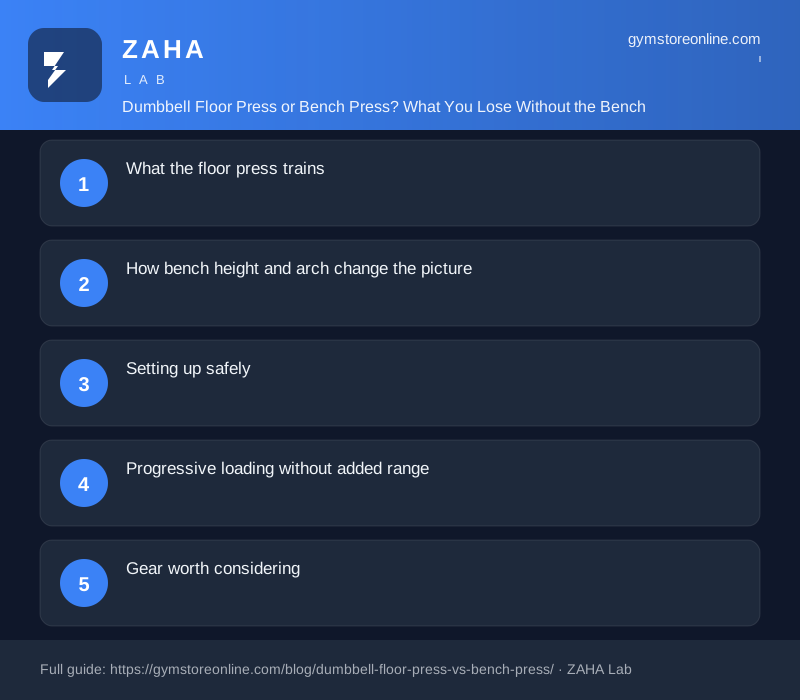
The floor cuts your pressing range by roughly 30 per cent. The dumbbell floor press is a real chest and triceps exercise, but it is not interchangeable with a bench press, and understanding the difference changes how you should programme either one.
What the floor press trains
When your upper arms contact the floor, the movement stops. That endpoint, around 90 degrees of elbow flexion depending on arm length, removes the deep stretch phase entirely. What remains is the mid-range and lockout portion of the press. The triceps work hard throughout, and the sternal fibres of the pectoralis major still fire across the pressing arc.
Leg drive disappears too. On a bench, a trained lifter generates force through planted feet, through the hips, and into the pressing path. The floor eliminates that option. Every kilogram lifted comes from the upper body alone.
How bench height and arch change the picture
A standard flat bench sits 43 to 48 cm off the floor. That height lets your shoulders drop slightly below chest level, opens the rib cage, and permits a mild thoracic arch. The arch shortens the pectorals slightly at the top and allows a fuller stretch at the bottom.
On the floor, the arch is limited to whatever your natural spinal curve allows against a flat surface. Shoulder blades can still retract and depress, which matters for shoulder health, but the angle of press changes. The dumbbells land sooner, the path is shorter, and the bottom stretch is reduced at every rep.
Setting up safely
Most people get this wrong the first time. Sit on the floor with both dumbbells resting upright on your thighs, then lie back and use your thighs to kick each dumbbell into the press position as you descend. Keep the elbows at roughly 45 degrees from the torso, not flared wide to 90 degrees.
Retract and depress your shoulder blades before the first rep. That position protects the rotator cuff and gives a stable base. Bent knees reduce lower back extension if needed. At the end of the set, lower both bells, rest the upper arms on the floor, then roll to one side before sitting up. Do not attempt to sit straight up holding loaded dumbbells. A good floor mat under your back and elbows makes repeated sets far more manageable.
Progressive loading without added range
The floor press responds to the same progressive overload logic as any other lift: add 1 to 2 kg across three to four weeks, then reassess. Because the range of motion is fixed, you cannot progress by increasing depth. Instead, change the tempo. A three-second lowering phase, a brief pause when the upper arms touch the floor, then press. Paused reps strip out momentum at the transition point and demand more from the chest and triceps where it matters.
Increasing total weekly sets before adding load is another reliable method. Neither approach requires equipment beyond what you already have.
Gear worth considering
Choosing the right dumbbells makes floor pressing at home much simpler. Here are three options to consider:
- The FEIERDUN adjustable dumbbell set of 2 takes up minimal floor space and covers a wide weight range from one compact unit.
- Selector-style adjustable dumbbells allow weight changes between sets in a few seconds, which suits density-style programming well.
- An equipment floor mat protects hard floors from dumbbell contact and cushions the elbows and upper back during floor work.
The full Dumbbells range on GymStoreOnline includes further options at different price points.
When a bench earns its floor space
A foldable flat bench folds to roughly 110 cm by 30 cm. Most spare rooms and garages absorb that footprint without difficulty. If your training involves regular pressing, rows, and incline work, a bench adds enough range and versatility to justify the space within a few weeks. The complete guide to weight benches for a home gym covers sizing, foldable options, and what to look for.
The floor press does not become redundant once a bench arrives. Paused floor press sets are a standard accessory exercise used to build lockout strength, and they fit into any programme alongside regular bench work.
If a bench is not possible yet, build a consistent floor pressing base over eight to twelve weeks and track the weight and sets. For a broader plan using only dumbbells, the dumbbell workouts at home guide covers a full training approach.
Frequently asked questions
Can the floor press replace the bench press entirely?
For most home gym settings it covers much of the same movement pattern, but the missing range and the absence of leg drive mean results will differ over time. If upper chest development and full pectoral stretch are priorities, a bench will be needed at some point.
How heavy can you go with the dumbbell floor press?
Most people find they can press similar weights to their bench press because the shortened range reduces the difficulty at the bottom position. That does not make heavier loads safer: the same technique rules apply, and rolling the dumbbells into position gets more demanding as the load increases.
Do I need a mat under the dumbbells when pressing on the floor?
A dense rubber mat protects hard floors from contact and reduces the noise of the elbows touching down between reps. Pressing directly on carpet can affect elbow and wrist alignment over repeated sets because the surface gives unevenly.