
YOLEO Adjustable Weight Bench for Home Gym, ENISO-Certified 375KG, 98% Pre-Assembled, Foldable G
£79.99
View on Amazon →
Published 17 September 2026 · updated 2026-09-17 · by GymStoreOnline
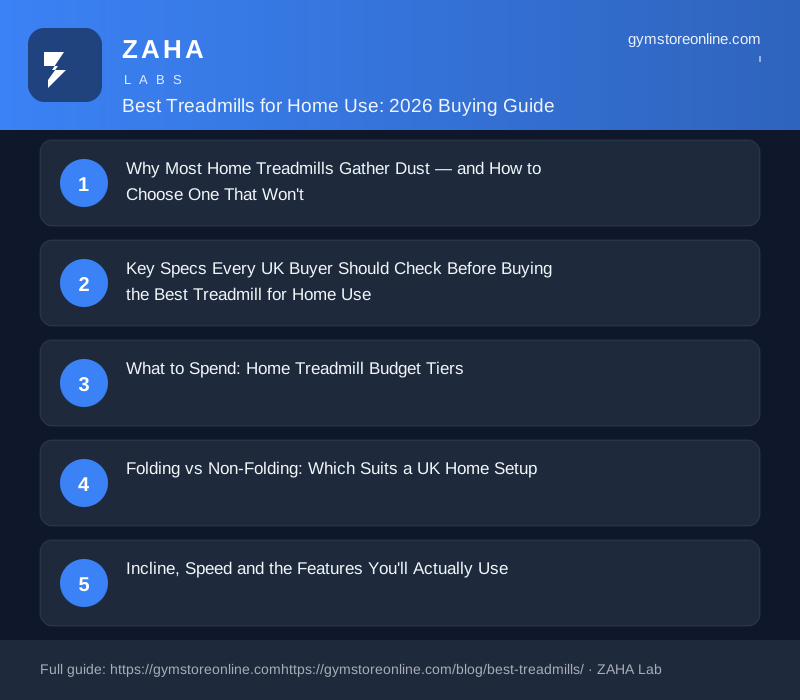
A home treadmill turns into an expensive coat rack when it doesn't fit the runner's stride, the room, or the routine. The best treadmills for home use earn their floor space every day by matching a handful of measurable specs: a continuous-duty motor of at least 2.5 CHP, a running deck of at least 55 × 20 inches, and a fold-flat footprint that genuinely disappears into a spare room.
Get those numbers right before you buy and the machine pays for itself. Miss one of them and you'll be shifting it to the hallway within three months.
Five numbers are worth benchmarking yourself against before comparing a single model. They apply regardless of brand or price tier.
Manufacturers list two motor figures: peak horsepower and continuous horsepower (CHP). Peak is a burst measurement that tells you little about a sustained 30-minute session. CHP is what the motor delivers throughout your run.
For walking only, 2.0 CHP is adequate. For jogging two or three times a week, 2.5 CHP is the sensible floor. For daily running, heavier users, or anyone running at pace rather than jogging, 3.0 CHP or above reduces motor strain and extends the machine's working life.
A belt shorter than 50 inches (127 cm) will clip your stride at running pace. The practical minimum for jogging is 55 inches; 60 inches suits taller runners or those with a long natural stride. Width matters too — 20 inches (51 cm) is standard for good reason, and anything narrower creates an uncomfortable anxiety about drifting off the edge during a fast session.
Every treadmill lists a maximum user weight. Don't buy to the limit. A machine rated to 100 kg worn by a 90 kg user will wear its frame, rollers, and belt faster than one rated to 120 or 130 kg. Build in at least 20–25 kg of headroom above your body weight; more if you run at speed rather than walk.
Folding treadmills lift the deck to a near-vertical position when not in use, freeing up valuable floor space. Many mid-range and premium folding models include a hydraulic soft-drop system that lowers the deck gently rather than letting it crash down. Check your ceiling height before buying: a raised deck on some folding models reaches 170–180 cm from the floor, which causes problems in rooms with lower ceilings.
Treadmills generate two kinds of noise: motor hum and impact noise from foot-strike. Impact noise depends on the deck's cushioning layer and your floor surface. In flats or rooms above living spaces, look specifically for machines with multi-layer cushioning or an impact-reduction system in the spec sheet. A rubber running mat placed under the machine reduces both noise and vibration transfer to the floor below.
Before committing, compare the listed belt length to your natural stride. A brisk walking pace generates a stride of roughly 70–80 cm; a running stride can reach 140–160 cm or more depending on your height and gait. A 50-inch (127 cm) belt is adequate for walking but feels cramped at running pace for most adults.
| Budget | What you typically get | What you give up |
|---|---|---|
| Under £400 | Basic folding models, 2.0–2.5 CHP, manual or 3-level incline | Short belt, lower weight capacity, basic console |
| £400–£800 | 2.5–3.0 CHP, 55-inch belt, auto-incline to 12–15%, better cushioning | Top speed often capped at 16 km/h |
| £800–£1,500 | 3.0+ CHP, 60-inch belt, app integration, commercial-grade rollers | Diminishing returns for casual users; larger footprint |
| £1,500+ | Commercial-grade motor, full touchscreen, high weight capacity | Overkill for most home use; significant floor space required |
For most UK home users — a couple of runs a week, one or two household members, moderate pace — the £400–£800 tier is the practical sweet spot. Spending beyond £800 earns its keep if you run daily, weigh over 100 kg, or want premium app integration that actively drives your training.
Folding treadmills dominate the home market because they solve the single biggest objection: a machine stored upright against a wall takes a fraction of the floor space of a fixed model. The engineering tradeoff is the fold hinge. On a quality machine from a reputable brand, that hinge will outlast your interest in the machine. On a budget model, hinges can loosen after a year or two of regular use.
Non-folding treadmills are typically sturdier at the same price point — there is no hinge to engineer — and they sit lower to the floor, which aids stability during fast runs. If you have a dedicated room and the machine will never need to move, a non-folding model often offers better value at any given budget.
Many listings lead with a large motor figure — "3.5 HP motor!" This is almost always a peak figure, not continuous. A motor advertised at 3.5 HP peak may only deliver 1.8–2.0 CHP under sustained load. Always look for the CHP rating explicitly in the spec sheet. If a listing shows only peak HP and never mentions CHP, treat the motor spec as unverified and check the manufacturer's technical sheet before buying.
Most home treadmills offer motorised incline from 0% to 12–15%. For general fitness, 12% covers the full range of effective walking workouts — including the popular 12-3-30 protocol (12% incline, 3 mph, 30 minutes) — which a solid mid-range machine handles without issue.
Speed matters less than most buyers expect. The majority of home users never exceed 14 km/h during a session. A machine capped at 16 km/h handles everything from a recovery walk to a solid tempo run. Only competitive runners regularly need the 20 km/h top speed found on premium models — and for most of those runners, outdoor running or track sessions are the primary training ground anyway.
For the console, the practical minimum is a clear display showing speed, time, distance, and estimated calories. Heart-rate monitoring via handlebar sensors is useful for effort tracking. Avoid paying a significant premium for a proprietary app ecosystem with a monthly subscription unless you're certain you'll use it consistently — many buyers find a simple display plus a phone holder for their own apps covers everything they need at lower cost.
A treadmill covers the cardiovascular side of a home gym but leaves strength training untouched. Pairing it with a weight bench or squat rack turns the space into a genuinely capable full-body setup.
The YOLEO Adjustable Weight Bench (from £69.99, 4.6 stars, ASTM-certified to 300–375 kg, 84–90 positions, 98% pre-assembled) covers incline, flat, and decline angles and folds away when not in use — a practical match for a folding treadmill in a shared space. Arriving nearly ready to use is a real advantage when you are already assembling a treadmill.
For a more complete strength setup, the YOLEO 400–900KG ASTM-Certified All in One Weight Bench Set (£99.99, 4.6 stars) adds an integrated bench press rack and a leg extension/curl fixture, covering the main compound movements without separate equipment purchases.
If budget headroom is tight, the OZE SPORTS Adjustable Weight Bench (£39.99, 4.5 stars) folds flat between sessions and covers incline, flat, and decline positions at a price that leaves more of the overall budget available for a better treadmill motor.
For those adding a barbell to the setup, the Yaheetech Adjustable Squat Rack (£49.98, 4.4 stars) includes a dip station and bench press support — a compact strength station that stores alongside most folding treadmills without consuming the entire room.
We applied a consistent set of filters across every treadmill recommendation on this page:
Machines that listed only peak horsepower without a CHP figure were excluded. Where a spec was ambiguous, we noted it as a criterion to confirm with the retailer rather than assuming a value.
Well suited to:
Think twice if:


For walking and light jogging, £400–£600 covers well-reviewed folding models with a 2.5 CHP motor and a 55-inch belt. For regular running or heavier users, £600–£900 adds commercial-grade rollers, better cushioning, and higher weight capacities. Spending over £1,000 makes sense mainly for daily multi-user households or competitive runners who want a near-gym experience at home.
Focus on continuous horsepower (CHP), not peak HP. For walking only, 2.0 CHP is adequate. For jogging three or more times a week, 2.5 CHP is the minimum worth buying. For sustained running sessions or users over 90 kg, 3.0 CHP or above keeps the motor from overheating under load and extends the machine's lifespan considerably.
Quality folding treadmills are perfectly capable for home use. The tradeoff is that the fold hinge adds a potential wear point over years of use. For most home users running three to five sessions a week, a mid-range folding machine from a reputable brand will last five or more years without issue. Non-folding models suit dedicated gym rooms where floor space is not a concern.
The machine's footprint is only part of the equation. Allow at least 0.5 metres of clearance behind the belt in case you step back at speed, and 0.5 metres on each side. A typical mid-range treadmill runs about 170–190 cm long by 70–90 cm wide when in use. Folding models reduce the stored footprint significantly, but the run space requirement stays the same during use.
As an Amazon Associate we earn from qualifying purchases. Prices and availability are accurate as of the date shown and are subject to change — the price on Amazon at checkout is the one that applies.
Find the best adjustable bench for ab and core workouts at home. UK guide covering angles, load ratings and picks under £100 for e
Everything you need to choose the best adjustable dumbbells for home workouts: weight range, locking mechanisms, build quality and
Build your home barbell and weight plate setup right: what to look for in bars, plates, squat racks and benches. Real specs, UK pr